

Firm News
Pro Bono Spotlight | A Call to Serve: Counsel Sasha Hodge-Wren Captains Voting Rights Hotline during Pandemic
In the most recent issue of its Social Impact Report, the firm focused on the issue of social justice as viewed through the prism of several fronts where justice has sometimes proved, if not elusive, then at least contested. One front discussed was the criminal justice system itself. Then we examined social justice in terms of economic opportunity. In the following article, we consider a third battlefront: the voting booth.
Every election is important, and vigilance over the seemingly incontrovertible right to safely vote remains critical every single year—yet, somehow, these stakes seemed even higher in 2020. With protest in the air like wildfire—which was also in the air—a fractious citizenry held very divergent views on not only the country’s future, but the reality of its present and past. On top of that social tinderbox, a global virus pandemic that had, by Election Day, killed well over 200,000 people in the United States alone produced logistical complications and concerns for a national election never before faced on such a scale.
Enter the Lawyers’ Committee for Civil Rights Under Law, a nonpartisan, nonprofit organization whose mission is to secure equal justice for all through the rule of law, targeting in particular the inequities confronting African Americans and other racial and ethnic minorities. Through its Election Protection coalition of more than 100 local, state and national partners, the organization works year-round to ensure that all voters have an equal opportunity to vote—and have that vote count—in large part through its management and administration of 866-OUR-VOTE, a national hotline providing assistance to callers at all stages of voting and on matters related to registration, absentee and early voting, casting a vote at the polls, and overcoming obstacles to their participation.
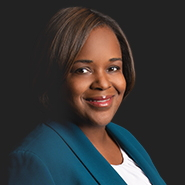
Miles & Stockbridge Counsel Sasha Hodge-Wren, resident in the firm’s Washington, D.C. office and representing clients throughout the nation’s capital, Maryland and Virginia, became affiliated with the hotline and its mission during the 2016 presidential election, when she served as a call volunteer. In 2020, she served as a volunteer Captain and eventually a Lead, taking on more responsibility in an even more challenging election cycle. “With all that has been going on this year particularly—I wanted to help where I could,” Hodge-Wren relates, “And, with a six-month-old infant at home, this was a way that I could serve the community remotely and still manage the day-to-day.”
That service—as a hotline Captain—included four-hour shifts providing supervisorial support to the approximately 40 volunteers working at her assigned call center at any one time. Beyond taking on the “tougher questions” that were funneled up to her from volunteers fielding them in real-time, Hodge-Wren also managed text message responses, delegated voicemail responses, coordinated solutions to tech issues and oversaw the tracking of each call that came in—a critical component, she notes, in case follow-up outreach, up to and including litigation. Hodge-Wren also assisted with the Call Center’s quality control and refreshed volunteer knowledge and training when appropriate. She also served as a bridge and buffer between volunteers and the paid professional staff administering the hotline.
A lot of the questions handled this year, unsurprisingly, centered around absentee and mail-in ballots. “With our experience of technology, there’s so much that can be taken for granted,” according to Hodge-Wren, describing the continued need for such a hotline. “We assume anyone can just look the answers up on the Internet, or go online to request a form or check their status. And we do—but not everybody can. Everybody doesn’t have the same access to the Internet, and without it, the process can become that much more daunting and often confusing.”
Volunteers often managed three-way calls with local election boards to help navigate any complexities or communication barriers. Hodge-Wren also points out that—counter to our assumptions—a lot of assistance was needed by college students amid shifting logistics in the wake of COVID-19, virus spikes and lock-downs.
And there was broad concern about voter intimation at the polls—“more than I have ever seen,” says Hodge-Wren. With conspiracies spreading virally across social media, and claims of hoaxes and radicalization across the political spectrum, potential voters—new and seasoned alike—were scared for their own safety. Add in the complications of COVID-19, and the very real health concerns of going to the polls and the hotline’s significant value couldn’t be clearer. “It’s important to inform the electorate how they can safely vote,” Hodge-Wren affirms. “No one should feel fear or apprehension about the act of voting.”
“It’s a right,” she continues, “And as such, needs to be defended, through education at first and, when necessary, litigation.”
And, as word of Hodge-Wren’s participation extended across the firm, volunteers across the firm joined the effort. By Election Day, at least 17 Miles & Stockbridge lawyers from across myriad practices and local offices had donated time to the initiative. Hodge-Wren was and is excited by the enthusiasm, and the way different colleagues from sometimes vastly different backgrounds came together to help shore up what is perhaps our most fundamental right, the one that protects all the others.
She also knows, though, that the need for such vigilance will probably not lessen in the next cycle. “This election is over,” She says, “but the battle for voting rights and safety at the polls isn’t. There is more work yet to be done.”
So when called again, Hodge-Wren will answer.