

Client Alerts 

New Maryland Law on Consumer Contracts Means Changes for Businesses
by Brian L. Moffet, Michael B. Brown on June 02, 2026

In 2025, Maryland’s General Assembly made it unlawful to shorten the limitations period in consumer contracts, defined as “contract[s] involving the sale, lease, or provision of goods or services that are for personal, family, or household purposes.” This prohibition applies prospectively to all consumer contracts entered into after June 1, 2026. The General Assembly went even further earlier this year and enacted House Bill 103 (HB 103), which prohibits businesses from including provisions in consumer contracts that waive, limit, impair or
Go


SCOTUS Coinbase Decision Gives Leverage to Parties Enforcing Arbitration Agreements
by Brian L. Moffet, Michael B. Brown on June 30, 2023
Last week, the U.S. Supreme Court held that litigation before the district court must be halted when a party appeals a denial of a motion to compel arbitration. In Coinbase v. Bielski, the court resolved a split among lower courts as to whether a stay of the proceedings was required during an interlocutory appeal on the question of arbitrability. This decision impacts countless business and consumer contracts containing arbitration clauses governed by the Federal Arbitration Act. Pointing to its holding in
Go
Convenience Fees: Not So Convenient for the Collectors
by Brian L. Moffet on January 24, 2022
Why Maryland Collectors of Consumer Debts Need to Be Concerned About Convenience Fees A recent Fourth Circuit Court of Appeals decision may have sweeping implications across the consumer debt collection industry in Maryland. In Alexander v. Carrington Mortgage Services, LLC, the Fourth Circuit held that a mortgage loan servicing company violated the Maryland Consumer Debt Collection Act and the Maryland Consumer Protection Act by charging debtors a convenience fee for making a one-time payment online or by phone, when the agreement
Go
Why an Opinion from the Eleventh Circuit Is Keeping Creditors Up at Night
by Brian L. Moffet on April 27, 2021
Close-up of letter with urgent stamp
A recent federal appeals decision is sending shockwaves throughout the financial services sector. In Hunstein v. Preferred Collection & Mgmt. Services, Inc., the Court of Appeals for the Eleventh Circuit held that, under the federal Fair Debt Collection Practices Act (FDCPA), businesses and individuals operating as “debt collectors” are prohibited from communicating debtor information to third-party service providers and vendors (such as mail processors) hired to send dunning correspondence or other communications “in connection with the collection of any debt.” In
Go
House Bill Would Expand Consumer Debt Collection Protections During COVID-19
by Brian L. Moffet on August 31, 2020
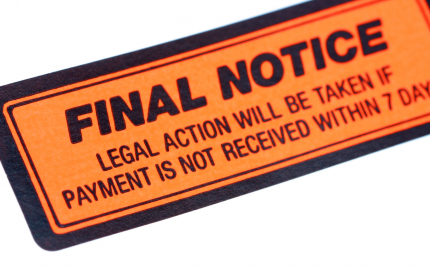
Orange sticker with black writing that says FINAL NOTICE Legal action will be taken if payment is not received within 7 days
A bill recently introduced in the House of Representatives would temporarily expand federal protections under the Fair Debt Collections Practices Act (FDCPA)—the federal statute that limits aggressive debt-collection activities. The House proposal, H.R. 7796 (titled the “Consumer Relief During COVID-19 Act”), is similar to a Senate bill that was introduced in March. Two major differences between the bills, however, are worth noting: First, as its title indicates, the Senate bill, S. 3565 (titled the “Small Business and Consumer Debt Collection Emergency Relief
Go
Congress Considers Expanding Federal Consumer Debt Collection Protections During National Emergencies
by Brian L. Moffet on May 14, 2020
With COVID-19 holding the global economy captive, Congress is attempting to head off what they predict will be an economic tidal wave of evictions, foreclosures and civil judgments by introducing The Small Business and Consumer Debt Collection Emergency Relief Act of 2020 (the “Bill”). Per its Senate sponsors, the Bill would modify and expand the Fair Debt Collections Practices Act or FDCPA (the “Act”)—the federal statute that regulates consumer debt collection practices—to better protect individuals during national emergencies and also
Go