


President Donald Trump signed an Executive Order (EO) on March 26, “Addressing DEI Discrimination by Federal Contractors,” reinforcing the Trump Administration’s stance on DEI programs and escalating the related restrictions on what the Administration considers “racially discriminatory DEI activities.”
The Executive Order, which took effect immediately, mandates that all federal government prime contracts, “contract-like” instruments and subcontracts, including lower-tier subcontracts, include a specific contract clause, requiring contractors to comply with the clause or risk potential False Claims Act (FCA) liability. Contractors
GoAssociate

Client Alerts
Doing business with the federal government historically has been competitive but relatively stable. Now, while the competition may remain, stability and certainty have all but disappeared. The uncertainty began with the flurry of Executive Orders issued during the first year of the second Trump Administration, including the kickoff of the “Revolutionary” Federal Acquisition Regulation (FAR) Overhaul (RFO).
The RFO represents an ambitious effort to fundamentally overhaul the FAR. Whether the RFO is necessary or prudent is a matter on which reasonable
Goby Roger V. Abbott, Lauren S. Fleming on August 29, 2025
The U.S. Supreme Court agreed last week to permit the National Institutes of Health (NIH) to terminate hundreds of grants related to diversity, equity and inclusion (DEI) initiatives worth approximately $800 million. The order was issued in response to the government’s emergency request to stay a lower court injunction barring the termination of the grants. The Supreme Court held that suits challenging these terminations must be brought before the Court of Federal Claims (CFC) and that, conversely, the federal district
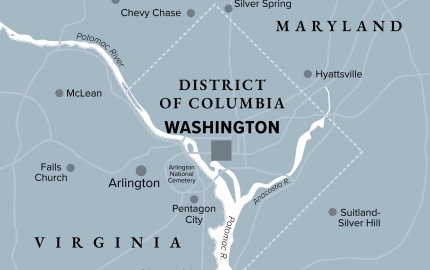
GoThis is part of a series discussing state-level bid protests in the DMV. Click here to read about the process in D.C. and click here to read about the process in Virginia.
Protest procedures in Maryland are less centralized than D.C. but more centralized than Virginia.
Generally Relevant Law
The majority of relevant authorities in Maryland are found in Division II of the State Finance and Procurement Article in the Maryland Code (SF&P) and Title 21 of the Maryland Code of Regulations (COMAR).
Authority to
GoThis is part of a series discussing state-level bid protests in the DMV. Click here to read about the process in D.C. and click here to read about the process in Maryland.
In the Commonwealth of Virginia, decentralization is the rule. Virginia state law generally vests procurement authority in the individual agency or locality, where a protest can move very quickly from submission to the awarding procurement authority onto appeal at the circuit court. With these principles in mind, here is a
GoThis is part of a series discussing state-level bid protests in the DMV. Click here to read about the process in Virginia and click here to read about the process in Maryland.
For a contractor who just expended significant time and money to bid on a DMV state-level government contract, only to watch the award go elsewhere, disappointment is understandable. But is this the end? What if the contractor believes that the state agency got it wrong? Can the contractor do anything? If so,
GoAlmost a year to the day after the Build America Buy America Act (BABA) became law, the federal Office of Management and Budget (OMB) has published its “Final Guidance for Grants and Agreements” intended to implement BABA’s domestic content preference requirements (88 FR 57750, Aug. 23, 2023).
BABA and Prior OMB Guidance
BABA was enacted last August as part of the Infrastructure Investment and Jobs Act (IIJA) (see sections 7091-70927, Pub. L. 117-58, 135 Stat 429). It imposes Buy America preferences for
GoThe U.S. Department of Defense (DoD) recently issued a proposed amendment to the Defense Federal Acquisition Regulation Supplement (DFARS) that tightens “Buy American” thresholds for DoD procurements. The Proposed Rule supplements and largely mirrors the Federal Acquisition Regulation (FAR) implementation of President Joe Biden’s Executive Order (E.O.) 14005, “Ensuring the Future is Made in All of America by All of America’s Workers,” while incorporating several DoD-unique requirements. Most importantly, the Proposed Rule introduces the following changes:
Increases the Domestic Content Threshold.
GoThe White House Office of Management and Budget (OMB) issued a Proposed Rule and Notification of Proposed Guidance to federal agencies earlier this year regarding the implementation of the Build America, Buy America Act (BABA), which imposes a government-wide preference for domestically produced iron and steel, manufactured products, and construction materials in federal infrastructure projects. The Proposed Rule builds upon the White House guidance for BABA released in April 2022. Although confusingly styled as “guidance,” the Proposed Rule proposes definitions
GoThe challenge posed to Department of Defense (DOD) contractors of complying with ever-shifting cybersecurity regulations and guidance continues unabated. On July 26, 2022, the Cyber Accreditation Body (Cyber AB) published a highly anticipated “Pre-Decisional Draft V1.0” of the Cybersecurity Maturity Model Certification (CMMC) Assessment Process (Draft CAP), which provides the procedures and guidance for CMMC Third-Party Assessment Organizations (C3PAOs) conducting official CMMC third-party assessments of organizations seeking certification (OSCs). The Cyber AB, formerly known as the CMMC Accreditation Body, is
Go