

Category: IP 

Highlights from the 2026 Hot Topics in Employment Law Seminar
by Grace Clarke, Elisabeth K. Hall on February 26, 2026
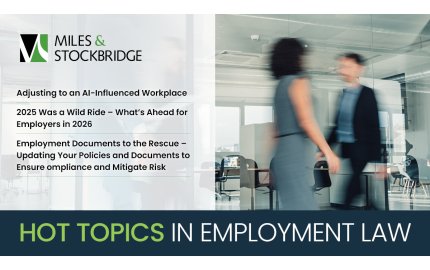
Miles and Stockbridge’s Labor, Employment, Benefits & Immigration Practice Group presented its 24th annual Hot Topics in Employment Law Seminar last week to business executives, human resources professionals and in-house counsel. Topics included navigating the use of AI in the workplace, updates from the National Labor Relations Board, immigration policy shifts, DEI policy enforcement and the importance of properly drafted employment documents. Here are highlights from the three interactive sessions. Adjusting to an AI-influenced Workplace AI continues to be a driving issue in
Go
Federal Judge Rules Attorney-Client Privilege Does Not Cover AI Conversations
by Matthew T. Wagman on February 20, 2026
Many people use AI tools in their daily lives without a second thought. In fact, many of us have ChatGPT aiding our searches on our personal phones. But a federal judge in New York recently found during a criminal trial that conversations with AI tools were not protected by attorney-client privilege. This decision is believed to be a first-of-its-kind ruling that could have significant ramifications for potential waivers of attorney-client privilege. According to prosecutors’ filings, the defendant, charged with securities and
Go
What Businesses Need to Know About Md.’s New Online Data Privacy Act
Maryland will soon have some of the strictest data protection and privacy requirements in the nation after the Maryland Online Data Privacy Act of 2024 (MODPA) was signed into law by Gov. Wes Moore last week. The law expands the scope of businesses’ personal data protection obligations and consumer privacy rights, offering protections that are aligned with contemporary concerns about data privacy and consumer autonomy. The MODPA goes into effect Oct. 1, 2025 and has a cure period that extends through April
Go
EU-US Data Privacy Framework, UK-US Data Bridge Ease Transatlantic Data Transfers
Sharing personal data across borders is critical for organizations operating and doing business internationally. Doing so in compliance with data security and privacy laws, however, can be a complex and challenging exercise due to the differing protections and transfer mechanisms across jurisdictions and countries. Thanks to recent developments between the United States, European Union and United Kingdom, U.S. companies once again have an easier pathway to share and receive data from their business partners and related entities in the EU
Go
Avoid Turning One Data Breach into Two
by Veronica D. Jackson, Thomas E. Zeno on January 24, 2022
Person sitting on a couch looking at a piece of mail.
When can a data breach can get worse? When the process of notifying victims creates a second breach. Take the example of a cancer treatment center that recently paid $425,000 to settle allegations that included a faulty notification process following a breach. The story provides an important lesson. One Breach Leads to Another It began with a spear phishing attack. Employees at the facility fell victim to the attack and their email accounts were compromised. The result: protected health information and other
Go
China’s 14th Five-Year Plan (2021-2025) and Its Impact on Your Intellectual Property Portfolio
by Ajay A. Jagtiani on August 03, 2021
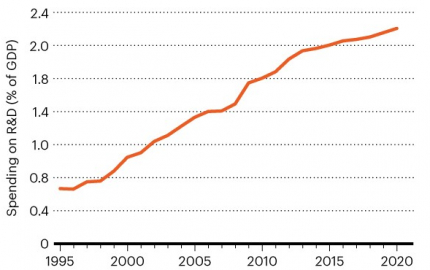
Chinese spending on R&D chart
In March of 2021, China’s most important annual political meetings took place as thousands of delegates to the National People’s Congress (NPC), the national legislature, and the Chinese People’s Political Consultative Conference (CPPCC), the top political advisory body, convened for a week at the Great Hall of the People in Beijing. Commonly known as the lianghui – or “Two Sessions” – this year’s elite gatherings in Beijing were particularly significant. The Chinese leadership not only set the national socio-economic and
Go
Promoting Competition in the American Economy Executive Order: Antitrust Is Back?
by Ajay A. Jagtiani on July 26, 2021
On July 9, 2021, President Biden executed an Executive Order (EO) on Promoting Competition in the American Economy. This EO impacts the Intellectual Property (IP) transactions and portfolios as discussed below. The EO directly mentions the information technology sector, the prescription drugs/healthcare sector, and the telecommunications sector as being in need of additional regulation. The EO states that the: information technology sector has long been an engine of innovation and growth, but today a small number of dominant Internet platforms use their
Go
Notice Alert: Properly Presenting Prophetic and Working Examples in a Patent Application
by Ajay A. Jagtiani on July 13, 2021
On July 01, 2021, the United States Patent and Trademark Office (USPTO) published a Notice requiring prophetic examples and working examples to be distinguished, at least, by using different tense in order to satisfy the written description and enablement requirements and comply with Applicant’s duty of disclosure. 1. What’s the difference between prophetic examples and working examples? Prophetic examples are experiments that Applicant described in a patent application but did not actually conducted. Therefore, the results described in prophetic examples are predicted
Go
Recent USPTO Announcements on Patent Entity Status and Trademark Fees
by Ajay A. Jagtiani on December 22, 2020
Two stamps and the stamper one saying registered trademark and one with an R with a circle around the letter and three paperclips.
Small Entity Government Use License Exception (Effective date: January 20, 2021) The United States Patent and Trademark Office (USPTO) is amending the rules of practice in patent cases to clarify and expand exceptions to the rule pertaining to government use licenses and their effect on small entity status for purposes of paying reduced patent fees. The rule change is designed to support independent inventors, small business concerns, and nonprofit organizations in filing patent applications and to encourage collaboration with the Federal
Go
The California Privacy Rights Act of 2020 Passed, Now What?
by Michele L. Cohen on November 05, 2020
Person holding a phone with a green shield and a lock in the center of the shield with blurry green computer code in the fore ground and back ground
On November 3, 2020, California voters passed Ballot Proposition 24,The California Privacy Rights Act of 2020 (“CPRA”), significantly amending the State’s recently effective California Consumer Privacy Act (“CCPA”), which is now known under the CPRA designation. Passage of CPRA means significant changes to CCPA, including the establishment of a new privacy enforcement agency, new definitions and usage limitations for sensitive data, and expanded breach liability. Businesses accessing and using the personal data of California residents are subject to CPRA and
Go
Beware: Trademark Email Scams for “Separate Registration of ‘Clients’” Are Not from the United States Patent and Trademark Office
Person on a laptop with the word SCAM and an envelope with a bug on it. A cup of coffee, glasses, a cellphone, and pen on the desk next to the computer.
The United States Patent and Trademark Office (USPTO) just issued a warning to be on the alert for “fraudulent emails that appear to originate from the United States Patent and Trademark Office (USPTO) domain, @uspto.gov.” The USPTO goes on to say: “These emails are a scam and do not come from the USPTO. Beware that these messages: Spoof the USPTO email address (e.g., noreply@uspto.gov).  Falsely claim that the USPTO has a new policy requiring separate registration of “clients” and that there is a “penalty”
Go
Can You Use Outside Counsel to Preserve Work Product Protection for A Forensic Breach Report?
by David R. Schaffer, Ajay A. Jagtiani on September 02, 2020
Hacker uses laptop to hack computer network and create cyber attacks
The answer, maybe, but it depends on the facts in each case. Merely because a company has its outside legal counsel directly retain a third party service provider for an incident response, i.e., digital forensics, does not guarantee that the forensic breach report provided to the outside counsel can be protected from disclosure under the attorney work product doctrine. In a recent court decision, In re: Capital One Customer Data Security Breach Litigation, E.D. Va., No. 1:19-md-02915, the court refused to
Go
Upcoming USPTO Fee Increases
Two stamps and the stamper one saying registered trademark and one with an R with a circle around the letter and three paperclips.
The United States Patent and Trademark Office (USPTO) is increasing many of the patent and trademark fees effective October 2, 2020. On average, the fees are increasing by 5 – 10 percent. Below is a summary of the larger changes and their economic impact on your portfolio.   Current Fees Final Patent Fee Schedule Fees Increase/(Decrease) Percentage Change Description Large Entity Fee Small Entity Fee Micro Entity Fee Large Entity Fee Small Entity Fee Micro Entity Fee Large Entity Fee Small Entity Fee Micro Entity Fee Large Entity Fee Small Entity Fee Micro Entity Fee Patent Application Filing Fees  Basic
Go
Trademarks in China: Traps for the Unwary
by Ajay A. Jagtiani on August 27, 2020
Foreign brand owners can file trademark applications in China as national applications (CNAs) or International Registrations (IRs) under the Madrid Protocol. There are pros and cons to each route, and brand owners may find it difficult to decide on the filing approach. There are no easy answers to this subject, but specification coverage is always one of the key considerations as specification defines the scope of protection of a trademark registration. A better understanding of the unique classification of goods
Go
Lessons Learned from a Cyberattack on Florence, Alabama
July 23, 2020
Computer screen showing a warning with a triangle and a exclamation point in the center under says system hacked.
Hackers used a phishing attack to infiltrate the city’s network and then deployed ransomware. On May 26, 2020, after receiving a tip from a dark web specialist, cybersecurity blogger Brian Krebs alerted the city of Florence, Alabama that hackers with a history of deploying ransomware had infiltrated the city’s network by stealing the credentials for the city’s IT manager in a May 6 phishing attack. Grateful for the tip, the city’s system administrator informed Krebs that the city took action to isolate
Go
CJEU Schrems II Case Ruling Invalidates EU-U.S. Privacy Shield Framework; Upholds Standard Contractual Clauses Validity (With Caveats)
by Michele L. Cohen on July 22, 2020
The Court of Justice of the European Union (CJEU), the EU's highest court, declared on July 16, 2020, that the EU-U.S. Privacy Shield framework for the transfer of personal data from the EU into the United States is invalid.  This ruling, issued in Data Protection Commissioner v. Facebook Ireland, Ltd., Maximillian Schrems, Case C-311/18 (E.C.J. July 16, 2020) (known more broadly as the Schrems II case), was one of the most highly anticipated court rulings of the year and will
Go
Willfulness No Longer Required for Trademark Owners to Be Awarded an Infringer’s Profits
by Karl W. Means on May 11, 2020
In a decision some believe may generate more trademark infringement litigation, the U.S. Supreme Court recently ruled that a trademark owner does not have to prove a defendant acted willfully to receive a profits remedy in some cases. On April 23, 2020, on appeal from the Second Circuit Court of Appeals, the Court decided Romag Fasteners, Inc., v. Fossil, Inc.  Under an agreement between Romag and Fossil, Romag made magnetic fasteners used on Fossil’s handbags and other products.  Romag learned, however,
Go
USTR Seeks Public Comments for Possible COVID-19-Related China Tariff Modifications
March 24, 2020
On March 20, 2020, the United States Trade Representative (USTR) announced that it was accepting public comments on possible modifications to the tariffs imposed on Chinese products as a part of the Section 301 action to address “China’s acts, policies and practices related to technology transfer, intellectual property and innovation.”  See. Although many medical/health-related products were excluded from these tariffs, the USTR is seeking identification of additional products currently subject to the tariffs that may be beneficial to combatting the
Go
Coronavirus Pandemic Increases Phishing Attempts
by Michele L. Cohen on March 13, 2020
Username and password written on a paper note in the shape of a fish attached to a hook
An unfortunate by-product of the current COVID-19 pandemic is the growing trend of phishing attempts using public concern over this crisis to trick people into clicking on malicious links posing as resource information.  Phishing scams are hardly new threats but the coronavirus outbreak creates a uniquely strong environment for these scams to be effective.  People are anxious for constantly updated and valid information regarding the pandemic. This crisis is particularly ripe for security incidents because COVID-19 has the potential for
Go
Biometric Data: Companies Should Act to Mitigate Risks in the Face of Growing Regulations and Increased Risk for Liability
There is a growing trend to regulate biometric data and severely punish companies that do not adequately protect this data. Every company that collects or uses biometric data should be careful to ensure compliance with applicable laws intended to protect this sensitive information. What is Biometric Data? Biometric data is generally defined as ‘unique physical identifiers including fingerprints, facial structures, iris scans, and voiceprints.’ While there are no current Federal laws governing the collection, use, and protection of biometric data, several states
Go
GDPR Food for Thought: Privacy Shield
by Michele L. Cohen, Veronica D. Jackson on August 10, 2018
The EU General Data Protection Regulation (GDPR) took effect on May 25, 2018. Potential fines for violating the GDPR include up to four percent of an organization's annual profits or €20 million (approximately $23 million), whichever is greater. Despite the risks associated with failing to meet the GDPR standards, many companies are still working towards compliance.   If you are among this group, it is critical to not give up but, rather, to focus on actively continuing efforts to achieve (and
Go
Patents: Lost & Found WesternGeco Provides for Recovery of Lost Foreign Profits
July 16, 2018
Patents are valuable intellectual property assets that grant their owners a limited monopoly over the sale and use of the patented subject matter for a fixed period of time. The patent permits its owner to recover potentially significant sums of money when their patents are infringed. Damages for patent infringement may include reasonable royalties, lost profits, and in the event of willful infringement, trebled damages. Each jurisdiction with a patent system grants patents that provide protection within that jurisdiction’s territory
Go
California’s Consumer Privacy Act – The Beginning of a National Data Privacy Law?
California enacted the California Consumer Privacy Act on June 28, 2018. This law broadly expands the rights of California residents in their personal information collected through online means. The law imposes requirements tied to disclosure of what personal data is collected, how it is used, and with whom a data collector shares this information. Individuals may opt out of having their data sold. Data collectors are also required to provide specific disclosures in connection with security breaches of the data.
Go
GDPR Food for Thought: Data Mapping
The EU General Data Protection Regulation (GDPR) took effect on May 25, 2018. Potential fines for violating the GDPR include up to 4 percent of an organization's annual profits or €20 million ($23 million), whichever is greater. Despite the risks associated with failing to meet the GDPR standards, many companies are still working towards compliance.   If you are among this group, it is critical to not give up but, rather, to focus on actively continuing efforts to achieve (and maintain)
Go
GDPR Food for Thought: Privacy Policies
The EU General Data Protection Regulation (GDPR) took effect on May 25, 2018. Potential fines for violating the GDPR include up to 4 percent of an organization's annual profits or €20 million ($23 million), whichever is greater. Despite the risks associated with failing to meet the GDPR standards, many companies are still working towards compliance.   If you are among this group, it is critical to not give up but, rather, to focus on actively continuing efforts to achieve (and maintain)
Go
A Patent for Personalized Medicine Survives §101 Challenge at the Federal Circuit and Will Exclude Generic Drugs from the Market until the Patent Expires
by Ajay A. Jagtiani on May 09, 2018
On April 13, 2018, the United States Court of Appeals for the Federal Circuit issued a decision in Vanda Pharmaceuticals Inc. v. West-Ward Pharmaceuticals Int’l Ltd  upholding the validity of U.S. Patent 8,586,610 (“the ’610 patent”), which claims a method of personalized treatment for schizophrenia. The Federal Circuit further affirmed the district court’s finding of infringement and awarding of injunctive relief that will exclude a generic version of Fanapt® in various strengths for treating schizophrenia from the market until the ’610
Go
The BEA-120 Mandatory Survey of Intellectual Property and Professional Services: June 29th Deadline for U.S Entities That Sold, Purchased or Licensed IP or Professional Services Abroad During 2017
by Russell V. Randle, Karl W. Means on May 08, 2018
For a U.S. person or business that sold to, or bought from, a foreign business or person $500 or more in certain services or intellectual property (“IP”) during the U.S. entity’s fiscal year ending in 2017, June 29, 2018 is the general filing deadline for submitting to the U.S. Department of Commerce, Bureau of Economic Analysis (“BEA”), a mandatory economics survey (Form BE-120). The Form BE-120 is a once-every-five-years survey conducted by BEA, titled “Benchmark Survey of Transactions in Selected
Go
Use of Patent Agents Increasingly Fortified
by Ajay A. Jagtiani, Marc W. Butler on March 08, 2018
On Friday, February 23, 2018, the Texas Supreme Court 1 overturned a lower court’s ruling that attorney-client privilege does not extend to patent agents. The ruling, bound to reverberate throughout the intellectual property industry, may bring relief to entities utilizing patent agents.   At issue was whether patent agents can assert attorney-client privilege to protect their communications with clients made in the context of patent prosecution. The issue arose in a dispute between inventor Andrew Silver and Tabletop Media LLC, which markets a
Go
The General Data Protection Regulation (GDPR): Steps to Consider to Achieve Compliance by May 2018
by Michele L. Cohen on December 12, 2017
The General Data Protection Regulation (GDPR), a uniform regulation aimed at protecting customer and employee personal information, becomes enforceable on May 25, 2018. The regulation will be implemented and applied in all 28 EU member countries 1 and will cover all EU data subjects. 2 While GDPR will impact the data collection and usage practices of virtually all businesses having access to the personal data of EU data subjects, many companies remain unprepared to meet their new compliance obligations. GDPR covers all companies having a
Go
December 31st Deadline to Re-Register a DMCA Designated Agent
by Karl W. Means on October 03, 2017
Online service providers have until December 31, 2017, to re-register a designated agent with the Copyright Office if they want to remain eligible for protection from copyright infringement liability under the Digital Millennium Copyright Act’s “safe harbor”. The 1989 Digital Millennium Copyright Act, also known as the “DMCA,” made significant changes to U.S. copyright law, including changes that offer online service providers such as website operators and Internet service providers protection from copyright infringement liability provided they meet certain eligibility requirements. The
Go
Cyber Crime Pays! Different Attacks Have Different Values
by Ajay A. Jagtiani on September 01, 2017
Cisco’s midyear report showed that CEO fraud netted cybercrime five times more money than ransomware 1 over the last three years. CEO fraud is a scam in which cybercriminals spoof company e-mail accounts and impersonate executives to try and fool an employee in accounting or HR into executing unauthorized wire transfers, or sending out confidential tax information. The FBI calls this type of scam “business e-mail compromise” and defines BEC as “a sophisticated scam targeting businesses working with foreign suppliers and/or businesses that regularly perform
Go
Is Your Medical Device Software Compliant with the New EU Standards?
by Ajay A. Jagtiani on August 30, 2017
The IEC 62304 standard 1 specifies life cycle requirements for the development of medical software and software within medical devices. It is a standard that is harmonized between the European Union (EU) and the United States (US). This standard spells out a risk-based decision model on when the use of Software Of Unknown Pedigree (SOUP) is acceptable. The standard was developed from the perspective that product testing alone is insufficient to ensure patient safety when software is involved.   The standard requires all
Go
So Why Do I Have To Sign This Declaration Again?
by Ajay A. Jagtiani on August 28, 2017
This is a question that I often am asked when inventors have been working with us for an extended period of time. In the past, we could use an existing, executed declaration in the family for a new member, but not after changes to the oath and declaration went into effect on September 16, 2012.   The changes to the Oath and Declaration are provided for in 35 U.S.C. §§ 115 and 118. Under the changes, someone other than an inventor
Go
Supreme Court to Review Digital Privacy (Part 2)
by Ajay A. Jagtiani on August 15, 2017
In our previous installment, we looked at the issues related to Carpenter 1. That discussion can be found here.   Another case involving the Stored Communications Act 2 may also come before the U.S Supreme Court in the upcoming October term. In Microsoft 3 the Court of Appeals for the Second Circuit found that the warrant did not apply to emails stored on a server in Dublin because there was no indication in the statute that Congress intended to authorize a search outside the United States. On June 22nd, the
Go
Uptick in University Enforcement of Intellectual Property an Indication of Stricter Enforcement Policy or a Passing Trend?
by Ajay A. Jagtiani on August 15, 2017
Universities have traditionally been reluctant to enforce their intellectual property (IP) against third parties. There are many reasons for this position, including adverse publicity associated with such suits, the time required to pursue such actions, and the risk associated with these suits. The failure by universities to enforce their IP rights against third party infringers has had a negative effect on diminishing the potential value of university originated IP. However, the wind may be shifting on this issue. A recent example
Go
Supreme Court to Review Digital Privacy (Part 1)
by Ajay A. Jagtiani on August 11, 2017
In 1986, Congress passed an obscure statute called the Stored Communications Act 1 that has become much more relevant 30 years later. The U.S. Supreme Court will have two opportunities to help define the scope of digital privacy under a law enacted when cellphones and email hardly existed. To obtain electronic communications, the government must obtain a warrant for any information that is held for 180 days or fewer by a computer service provider. This means the government must establish probable cause that the
Go
Russian Cyber Attack on US Nuclear Power Stations
by Ajay A. Jagtiani on August 11, 2017
A report from the FBI and the Department of Homeland Security warns of malware attacks targeting mainly nuclear power stations and energy facilities. The attacks started in May of this year. These attacks have received an “amber” terrorism threat rating, the second highest threat rating available on the Department of Homeland Security’s advisory system, and thus far appear to be credential spear phishing 1 attacks attempting to map infiltrated networks. The attackers targeted employees at the affected energy organizations through phony resumes with
Go
Back to the Future: Saving Millions with Opinions of Counsel Post-Halo
by Andrew W. Wahba, Ajay A. Jagtiani on August 03, 2017
After a decade of atrophy, opinions of counsel may again be an essential part of any defensive patent strategy due to recent changes in the law.  The Supreme Court in Halo overruled the Federal Circuit’s Seagate test for enhanced damages. 1 By eliminating Seagate’s requirement for objectively reckless conduct on the part of the accused infringer and lowering the patent owner’s burden of proof, Halo has undoubtedly made it easier for patent owners to seek enhanced damage awards, i.e. up to treble damages. In contrast to enhanced damages, opinions of counsel could
Go
University Business Collaborations Bridging the Gap
by Ajay A. Jagtiani on July 24, 2017
Historically, our understanding of University Business Collaborations (UBC) is based on the role of barriers in the development of cooperation. During the June 2017 University Industry Innovation Network (UIIN) annual meeting, various participants discussed strategies and practices to manage and overcome barriers to support successful UBC. One assumption is that once barriers are overcome, the road is paved for collaborations. This assumption by questioning the barrier’s significance in UBC is discussed below. Are barriers the main influencing factor in the process
Go
Phishing Moves to SMiShing
by Ajay A. Jagtiani on July 19, 2017
Phishing, the fraudulent practice of sending emails purporting to be from reputable companies in order to induce individuals to reveal personal information (such as passwords and credit card numbers) is something that we have grown accustomed to. Today, the bad guys are getting more sophisticated. For example, they are using SMiShing 1 attacks. SMiShing (SMS phishing) is a type of phishing attack where mobile phone users receive text messages containing a Web site hyperlink, which, if clicked would download a Trojan horse
Go
New Guidelines for Examination of Computer Related Inventions in India
by Ajay A. Jagtiani on July 18, 2017
On July 3, 2017, revised Guidelines for Examination of Computer Related Inventions (CRIs) were released. The full text of the guidelines may be found here. The revised guidelines omit the onerous requirement of pairing software-invention claims with novel hardware, wherein the contribution of the latter lies in the implementation of the computer program via a method. This will broaden the scope of patentability of computer related inventions in India.   The guidelines suggest that “it is important to ascertain from the nature of the
Go
A Federal Cybersecurity Law Coming Your Way?
by Ajay A. Jagtiani on July 14, 2017
On Thursday, June 29, 2017, Sens. Hatch and Markey introduced the “Promoting Good Cyber Hygiene Act” that would direct the National Institute of Standards and Technology (NIST) to establish a set of baseline voluntary best practices for safeguarding against cyber intrusions that would be updated annually. The legislation would also direct the Department of Homeland Security (DHS) to study cybersecurity threats to internet-connected devices generally referred to as the “Internet of Things.” Similar legislation was introduced in the House by
Go
New Rule on Trademark Revivals, Reinstatements, and Petitions to the Director
by Ajay A. Jagtiani on July 12, 2017
Effective July 8, 2017, new rules went into effect regarding revival of abandoned applications, reinstatement of abandoned applications and cancelled or expired registrations, and petitions to the director. 1 The rules have two goals: Identify the existing deadlines and requirements for filing a petition to revive, petition to the director, and request for reinstatement; and Promote the integrity of the Trademark database by generally not reinstating or reviving applications or registrations more than six months after they have abandoned, cancelled, or expired.   Thus, if you
Go
Intellectual Property Litigation Financing
by Ajay A. Jagtiani on July 10, 2017
IP litigation is expensive and risky. A patent owner relies on costly experts and attorneys, and confronts the possibility that the entire case could be dismissed at any point during a lengthy litigation process (likely against a well-heeled, seasoned opponent). The patent legal landscape has continued to become more challenging, with patent owners now virtually guaranteed to be required to dual-track Patent Trial and Appeal Board proceedings alongside litigation. Given increased demand for litigation finance in the IP space, it’s more crucial
Go
Whoops, I did not want to file that European Application. Can I get a Do-Over?
by Ajay A. Jagtiani on July 07, 2017
It is rare, but there are times where one will file a European Application (EA) and then change their mind due to business considerations. Filing fees are a significant part of the fees associated with filing an EA. The rules relating to the refund of fees is found in Article 11 of the European Patent Convention (EPC). Article 11 was amended on June 29, 2016 to clarify when fees can be refunded.  From now on, the examination fee shall be refunded: a) 
Go
India – Antitrust Law Update
by Ajay A. Jagtiani on July 05, 2017
In 2009, the Indian government implemented provisions under the Competition Act of 2002 for prohibition of anti-competitive agreements and abuse of dominant positions in India. 1 More recently, antitrust litigation has picked-up in India as the general public has become aware of various issues such as price fixing, cartel formation, tying arrangements and predatory pricing. 2 On June 1, 2017, the Competition Commission of India (CCI) passed an order on a complaint between Fight for Transparency Society (Society) and WhatsApp Inc. (WhatsApp) alleging abuse of a dominant
Go
Does BREXIT Really Matter to Me in the United States?
by Ajay A. Jagtiani on June 27, 2017
Well, if you are a company doing business in Europe and have registered your trademarks, it will. As you know, the United Kingdom (UK) has decided to leave the European Union. This has implications as regards the protection under your European Union trade mark(s), namely: When the UK exits the European Union, EU trade mark registrations (EUTMs) will no longer apply in the United Kingdom.     Arrangements MAY be put in place effectively to validate existing EUTMs in the UK, but it
Go
The Supreme Court Clarifies Patent Rights After a Patented Item is Sold
by Ajay A. Jagtiani on June 23, 2017
On May 30, 2017, in Impression Products 1, the U.S. Supreme Court ruled that a patent owner’s sale of an item, either within or outside the United States, exhausts all of the patent owner’s patent rights in that item, regardless of any restrictions the patentee purports to impose upon the sale. This Court’s decision solved long-term unsettled issues with respect to patent owners’ post-sale restrictions on the use or resale of patented items. Over the years, disputes have arisen with respect to the
Go
Replacement at the Head of the U.S. Patent and Trademark Office
by Marc W. Butler on June 15, 2017
Michelle K. Lee, Under Secretary of Commerce for Intellectual Property and Director of the U.S. Patent and Trademark Office (USPTO) for more than two years, submitted a letter of resignation on the afternoon of Tuesday, June 6, 2017. Lee was nominated by President Barack Obama and confirmed to the role in March 2015. A former Google executive who advocated strongly for women and minorities, Lee took the helm of the patent office at a pivotal time for the technology industry. U.S. Secretary
Go
U.S. Antitrust Agencies Issue Guidance for HR Professionals & Announce Intention to Criminally Prosecute Wage-Fixing and “No Poaching” Agreements
by John E. McCann, Jr. on November 15, 2016
The U.S. Department of Justice (DOJ) and Federal Trade Commission (FTC) (collectively the “Agencies”) have issued new Antitrust Guidance for Human Resource Professionals. The new Guidance is designed to “alert human resource (HR) professionals and others involved in hiring and compensation decisions to potential violations of the antitrust laws.”  The Agencies state that they will bring enforcement actions against employers who have agreements with other employers to limit or fix wages or other terms of employment, or to improperly exchange
Go
Federal Circuit Resolves Debate over Pleading Standard for Infringement of Design Patents
by John E. McCann, Jr., Robert S. Brennen on February 27, 2013
In a split decision, the United States Court of Appeals for the Federal Circuit has resolved the hotly debated issue of the proper standard for pleading infringement of a design patent in Hall v. Bed, Bath & Beyond, -- F.3d --, 2013 WL 276080 (Fed. Cir., Jan. 25, 2013).  Since the Supreme Court’s landmark decisions in Twombly/Iqbal, lower courts have debated the applicability of the heightened “plausibility” pleading standard in the context of complaints alleging infringement of design patents.  In
Go