The Federal Trade Commission (FTC) announced Jan. 10 annual revisions to the applicable thresholds under the Hart-Scott-Rodino Antitrust Improvements Act of 1976, as amended (the HSR Act). These revisions will apply to all transactions closing on or after the effective date of the notice, which will be 30 days after its publication in the Federal Register. The new minimum size of transaction threshold has been adjusted upward from $119.5 million to $126.4 million.
Under the HSR Act, the parties to any
A federal judge in Kentucky on Thursday ruled the 2024 Title IX regulations were “arbitrary and capricious” and in violation of the Administrative Procedures Act (APA). Unlike other courts that had issued injunctions preventing the regulations from being implemented in certain states or by certain schools, this court ordered the rule to be vacated, which means that it now may not be enforced by the Department of Education anywhere in the nation. The 2020 regulations that were in place prior
President Joe Biden signed into law last week the Servicemember Quality of Life Improvement and National Defense Authorization Act for Fiscal Year 2025 (NDAA). This defense policy and budget bill contains a discretionary topline of $895.2 billion to be split between the Department of Defense (DoD), Department of Energy (DOE) and other agencies for national defense related spending.
The NDAA is a critical piece of legislation that guides the creation of many federal procurement regulations, and this year is no different.
The Small Business Administration (SBA) published earlier this month one of the most significant rule changes in recent history. We previously addressed the new M&A and long-term recertification rules. Now, we’ll examine the homogenization of the negative control rules across the SBA’s small business and socioeconomic programs, as well as the approval of rights of first refusal (ROFRs) for all these programs.
These rule changes could materially improve access to capital for 8(a) program participants, woman-owned small businesses (WOSBs) and
The Small Business Administration published a gargantuan new rule Tuesday that will significantly change small business contracting for years to come.
The rule was styled “HUBZone Program Updates and Clarifications, and Clarifications to Other Small Business Programs,” and while a large swath of the rule is directed at the HUBZone program, the most consequential changes affecting the largest number of contractors are the “Other Small Business Programs” updates. These changes affect how small businesses calculate their size, permit minority investment, leverage past performance
The Court of Appeals for the Federal Circuit last month granted the Government’s petition for rehearing en banc of the precedent-setting decision in Percipient.ai, Inc. v. United States. A divided panel of the Federal Circuit held in June that a prospective subcontractor had standing to challenge the Government’s alleged failure to adhere to the statutory preference for commercial items.
The decision thus expanded the definition of “interested party” under the Tucker Act much more broadly than previous decisions of the Federal
(The following was originally posted Dec. 7, 2023.)
It’s the most wonderful time of the year, full of holiday cheer but, unfortunately for some employers, also legal risks and potential liability. A company’s annual holiday party, gala or event can quickly turn from a celebration into a headache. That’s why now is a good time for employers to ensure they have policies in place on the overconsumption of alcohol and harassment. Additionally, employers should consider their possible exposure and ways to
The Federal Acquisition Regulatory (FAR) Council issued an interim rule earlier this month revising FAR 52.204-7 to require offerors to be registered in System for Award Management (SAM) at two points in time: “[1] when submitting an offer or quotation and [2] at time of award.” The interim rule clarifies that offerors are not required to be continuously registered in SAM between those two dates, which is how decisions by the Government Accountability Office (GAO) and the Court of Federal
The National Labor Relations Board held last week that captive audience meetings violate Section 8 of the National Labor Relations Act. A captive audience meeting occurs when an employer requires employees to attend anti-union meetings or face discipline or discharge.
The Nov. 13 decision in Amazon.com Services overturns a 1948 decision, with the board unanimously holding that captive audience meetings have a “reasonable tendency” to interfere with employees’ exercise of their rights under Section 7 of the NLRA, which includes the
The weather may be turning colder in Maryland but employers now have new obligations under state law to protect employees against heat hazards. Maryland’s Occupational Safety and Health (MOSH) Division of Labor and Industry recently published its Heat Illness Prevention Standard. It became effective Sept. 30, shortly after the Federal Occupational Safety and Health Administration (OSHA) released a proposed rule for comprehensive heat injury and illness prevention. The Standard differs slightly from OSHA’s proposed rule, specifically for rest periods when
On November 15, 2024, a federal judge vacated and set aside the final rule issued by the Department of Labor (“DOL” or the “Department”), which increased the salary threshold required to classify certain positions as exempt under the white-collar exemptions of the Fair Labor Standards Act (“FLSA”). As a result of the ruling, the $58,656 salary threshold increase set for Jan. 1 will no longer take effect and the prior increase (from $35,568 per year to $43,888 per year) which
Maryland’s Time to Care Act (TTCA), enacted more than two years ago and since amended twice, established a paid family and medical leave insurance (FAMLI) program for Maryland employees. The Maryland Department of Labor’s new FAMLI Division recently issued proposed regulations to implement the program in accordance with the TTCA.
Applicable to all employers with at least one Maryland employee, FAMLI will provide eligible employees in Maryland with 12 weeks of paid family and medical “leave and benefits” for certain qualifying
The Department of Defense (DoD) published a Final Rule earlier this month formally implementing the Cybersecurity Maturity Model Certification (CMMC) Program. This Final Rule is the culmination of five years of work to standardize the safeguards that government contractors must implement to protect Federal Contract Information (FCI) and Controlled Unclassified Information (CUI) while also bolstering compliance with these requirements.
(For more background on the road to the Final Rule, please read our earlier blog posts on what we’ve called “CMMC Program
The Maryland Department of Health (MDH) released an updated policy manual at the end of September for the 2025 Conrad 30 Waiver Program application cycle, which opened Oct. 1. Changes include an online-only submission process, flexibility for the three-providers- per-practice-site limitation, and guidance regarding telehealth. The Conrad 30 program is one avenue for an immigrant physician to obtain a waiver of the two-year home residency requirement and help alleviate the physician shortage in the United States. (For an overview of the
A slew of new employment laws take effect Tuesday in Maryland related to job postings, wage statements, discrimination, prevailing wages and workplace fraud, among other topics. Notably, Maryland employers should be apprised of the following:
Salary Transparency in Job Postings
As discussed in greater depth earlier this year, Maryland employers are now required to include the “wage range” for all open and posted job positions. “Wage range” is defined as the minimum and maximum hourly rate or salary for a position, set
As of Oct. 1, health care providers in Maryland must maintain patient medical records and laboratory and X-ray reports for at least seven years after the records and reports are created. The new law increases the record-retention requirement from five years. For a minor patient, records and reports must be maintained until the minor patient reaches the age of majority plus seven years, which for most patients will be when they are 25 years old.
Health care providers, which include hospitals
The Commonwealth of Massachusetts will offer a limited tax amnesty for certain “eligible taxpayers” from Nov. 1 through Dec. 30.
“Eligible taxpayers” can forward and bring their tax liabilities up to date and receive a penalty abatement. This group includes businesses, individuals, trusts and estates. Taxpayers that are currently in resolution with the Massachusetts Department of Revenue have pending cases or open collection cases will qualify for amnesty along with taxpayers that have unfiled returns or underreported returns.
Amnesty claims must be
The CMS Innovation Center (CMMI) continues to prepare for its next episode-based alternative payment model, the Transforming Episode Accountability Model, or TEAM for short. This five-year model will offer both incentive payments for meeting a pre-determined target price and downside risk to TEAM hospitals that exceed that target price.
TEAM will be a mandatory program for almost 750 hospitals selected by CMMI in specific geographic areas, including Washington, D.C., northern Virginia, Connecticut, Vermont and the greater New York City/New Jersey area.
The U.S. District Court for the Northern District of Texas issued its decision Tuesday that the business world had been awaiting with bated breath, striking down the Federal Trade Commission's (FTC) final rule making unlawful virtually all noncompete agreements. Unlike the preliminary injunction granted by the court last month, which was limited only to the parties, the court this week “set aside” the FTC rule, which now may not be enforced by the federal agency anywhere in the nation.
The Court’s
We are less than 100 days away from Election Day 2024, so it is critical for employers to ensure that they are following applicable voting leave laws in the states where they have employees.
Not all states require employers to provide employees with leave to vote. But several require employers to provide employees with one or more hours of voting leave, and a vast majority of those states require employers to pay employees for that time. Below is a roundup of
As record-high temperatures enveloped most of the U.S. earlier this month, the federal Occupational Safety and Health Administration (OSHA) released a proposed rule for comprehensive heat injury and illness prevention. The proposed rule, “Heat Injury and Illness Prevention in Outdoor and Indoor Work Settings,” was many years in the making and would affect employers throughout the United States. In the interim, OSHA and various state regulators that have not already adopted their own laws are issuing citations under Section 5(a)1
The Virginia Business Professional and Occupational License (BPOL) is a local level tax levied on businesses’ gross receipts. Rates typically range from $0.03 to $0.58 per $100 of gross receipts, depending on the locality and industry classification. The tax is calculated based on the previous year’s receipts and filed annually. As a turnover tax, BPOL generally does not allow deductions for business expenses, and exemptions typical for sales and use taxes do not apply. However, there are certain exclusions that
In a unanimous decision, the Supreme Court of the United States recently determined in Connelly v. U.S. that the value of a life insurance policy must be included in the fair market value of a closely held business for purposes of determining the value of a decedent’s interest. Further, the Court stated that any contractual obligation of the business to re-purchase a decedent’s interest does not create an offsetting liability to a life insurance policy. This decision is significant for
On July 3, 2024, the U.S. District Court for the Northern District of Texas issued a limited stay and preliminary injunction of the Federal Trade Commission's (FTC) final rule making unlawful virtually all non-compete agreements. This is an important decision and a win for business groups seeking to invalidate the rule. However, it does not put an end to the rule, as the court specifically rejected the request by plaintiffs for a nationwide injunction, instead limiting the application of the
Louisiana recently passed new legislation prohibiting employers from including nondisclosure provisions in agreements with employees that prospectively forbid employees from disclosing or discussing certain facts or claims concerning sexual harassment.
Specifically, effective August 1, Louisiana employers will be prohibited from including in agreements with employees a “nondisclosure clause,” defined as “an agreement between an employee and employer that prevents, or has the effect of preventing, an employee from disclosing or discussing a hostile work environment, allegations of a hostile work environment,
The Court of Appeals for the Federal Circuit (CAFC) continues to redefine the Court of Federal Claims’ (COFC) ability to hear cases affecting all stages of the federal procurement process.
Last year alone witnessed decisions in which the CAFC established the Tucker Act’s “interested party” analysis as a matter of statutory standing only, recharacterized its long-standing waiver rule for solicitation defects as a non-jurisdictional claims-processing rule and rejected the notion that the Contract Disputes Act’s “sum certain” requirement could be used
More than a dozen business groups last month filed a much-anticipated lawsuit seeking to block the U.S. Department of Labor’s (DOL) new final rule that will significantly raise the minimum salary thresholds for exempt employees under the Fair Labor Standards Act (FLSA).
The final rule increases the minimum annual salary threshold for exempt executive, administrative, and professional (EAP) employees, as well as outside sales and computer employees from $35,568 per year to $43,888 per year July 1. Then, on Jan. 1,
The Environmental Protection Agency (EPA) chooses criminal, civil or administrative enforcement based on its assessment of the severity of violations. A significant development in EPA’s enforcement strategy has been the increased integration and collaboration between its civil and criminal enforcement offices.
To further its enforcement program, the EPA recently introduced the Strategic Civil-Criminal Enforcement Policy. This policy replaces previous guidelines, is effective immediately and according to the EPA aims to address modern environmental challenges more effectively.
The key takeaways from this policy
Maryland has long been a solar-friendly state, and the Brighter Tomorrow Act, signed into law by Gov. Wes Moore last month, will expand access and adoption of solar energy. The legislation is both a supportive and forward-looking policy aimed at enhancing sustainability, economic growth and technological advancement within Maryland.
Some of the key takeaways from the act are:
Creating the Small Solar Energy Generating System Incentive Program by the Maryland Public Service Commission (PSC). The program will allow eligible solar energy generating
Maryland will soon have some of the strictest data protection and privacy requirements in the nation after the Maryland Online Data Privacy Act of 2024 (MODPA) was signed into law by Gov. Wes Moore last week. The law expands the scope of businesses’ personal data protection obligations and consumer privacy rights, offering protections that are aligned with contemporary concerns about data privacy and consumer autonomy.
The MODPA goes into effect Oct. 1, 2025 and has a cure period that extends through April
Under new legislation amending Maryland’s Equal Pay for Equal Work Law, employers in the state will be required, as of Oct. 1, to include certain wage information in both public and internal job postings and advertisements. This includes any solicitation intended to recruit applicants for a specific available position, such as recruitment done directly by an employer or indirectly through a third party. These new disclosure requirements will apply to any position that will be physically performed, at least in
The Supreme Court last month made it easier for employees who are involuntarily transferred from one position to another to pursue employment discrimination claims under Title VII of the Civil Rights Act of 1964.
Traditionally, for a transfer to constitute a sufficient change to the terms and conditions of employment to establish a discrimination claim, an employee needs to demonstrate that they were left at a significant disadvantage because of the transfer. In Muldrow v. City of St. Louis, Missouri, the
Schools that have been anxiously awaiting the U.S. Department of Education’s final regulations enforcing and interpreting Title IX need wait no longer. The department issued final regulations last week that will govern sex discrimination complaints relating to conduct that occurs after Aug. 1, 2024. The new regulations include significant changes from prior Title IX regulations issued in 2020.
The final regulations, among other changes, raise the bar for schools’ compliance, change the definition of sexual harassment, expand protections for LGBTQ+ and
Miles & Stockbridge attorneys participated today in a call with the U.S. Chamber of Commerce for an update on litigation the Chamber has filed to stay or enjoin the effectiveness of the FTC rule banning almost all employee non-competes. (Click here to read our summary of the rule.)
Here are some key takeaways from the call:
The Chamber filed a lawsuit in U.S. District Court for the Eastern District of Texas challenging the rule and seeking to stay or enjoin the effectiveness of
As we previously wrote when the Pregnant Workers Fairness Act (PWFA) went into effect in June 2023, the law requires most employers with 15 or more employees to provide “reasonable accommodations” for a qualified employee’s known limitations related to pregnancy, childbirth or related medical conditions unless the accommodation will cause the employer an undue hardship. Last week, the Equal Employment Opportunity Commission (EEOC) issued a Final Rule to implement the PWFA.
The Final Rule clarifies that, to be protected under the
The Department of Labor (DOL) on Tuesday increased the salary thresholds for the Fair Labor Standards Act (FLSA) white collar exemptions from overtime pay requirements. On July 1, the minimum annual salary threshold for an exempt employee will be $43,888 ($844 per week), up from $35,568 ($684 per week). This threshold will increase to $58,656 ($1,128 per week) on Jan. 1, 2025. To qualify for the FLSA’s highly compensated employee exemption, employees will now have to earn $132,964 per year
The Federal Trade Commission (FTC) on Tuesday, in a 3-2 vote, approved a final rule banning non-competes in almost all employment contexts. This sweeping rule, while not unexpected, has caused quite a stir among employers and workers alike. Here is what employers need to know.
Background
The rule, which was first proposed in January, comes on the heels of the Biden administration’s 2021 executive order designed to “promote competition in the American economy, which will lower prices for families, increase wages
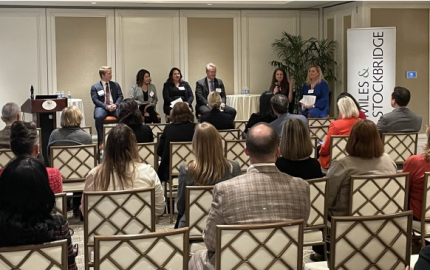
Miles & Stockbridge’s Labor, Employment, Benefits & Immigration Practice Group presented its 22nd annual Hot Topics in Employment Law seminar April 11 to clients from throughout Maryland and beyond. Topics covered included diversity, equity and inclusion programs, federal and state leave law updates and myriad employment issues raised on a day-to-day basis with human resources professionals, including disability and religious accommodations in the workplace, the impact of changing cannabis and clean slate laws on employers. Here are some highlights from
Companies competing for federal contracting opportunities now have yet another reason to fear their proposals being rejected and their awards getting overturned.
A recent decision by the Government Accountability Office (GAO) held that continuous registration in the System for Award Management (SAM) is mandatory throughout the evaluation period for an offeror to be eligible for award, even if a period of lapsed registration is as short as 24 hours. If that were not concerning enough, GAO is not alone in its
A New York law recently went into effect significantly limiting employers’ ability to make inquiries regarding employees’ personal social media accounts.
Specifically, the new law makes it unlawful for an employer to request, require or coerce any employee or job applicant to:
disclose any username and password, password or other authentication information for accessing a personal account through an electronic device[1];
allow the employer to access the employee's or applicant’s personal account in the presence of the employer; or
reproduce pictures, videos or other
U.S. Deputy Attorney General Lisa Monaco delivered keynote remarks March 7 at the American Bar Association’s 39th National Institute on White Collar Crime. In addition to unveiling a new whistleblower pilot program, she discussed the rise of artificial intelligence (AI) and DOJ’s continued effort to fight corruption at the hands of people using AI to further their illegal activities.
Just because an unlawful activity is done by or orchestrated with AI does not mean it is not illegal. “Fraud using AI
A federal judge in Vermont last month ruled a plaintiff’s medical marijuana use was not protected by the Americans with Disabilities Act. In Skoric v. Marble Valley Regional Transit District et al., the plaintiff was fired by his employer for failing a random drug test by testing positive for marijuana despite having a valid, state-issued medical marijuana card and being prescribed medical marijuana to treat his chronic pain and depression.
In granting the motion to dismiss, the court considered whether the
U.S. Deputy Attorney General Lisa Monaco delivered keynote remarks March 7 at the American Bar Association’s 39th National Institute on White Collar Crime. Emphasizing the need for a culture of compliance, Monaco highlighted the continued importance of existing DOJ programs, including those related to corporate claw backs, acquisition-related disclosures and voluntary self-disclosure.
Monaco also announced that the Department of Justice is designing a new whistleblower program that will use monetary rewards to strengthen corporate enforcement efforts and proactively incentivize individuals to
Maryland Comptroller Brooke Lierman issued a letter Feb. 28 to address the challenges and concerns of tax practitioners regarding the policy and procedural changes to pass-through entity (PTE) filings and payments. Most significantly, the comptroller has agreed to provide a one-time waiver for taxpayers who missed electing PTE treatment on the first filing of the year.
Background
The comptroller said last April that, for tax years beginning after Dec. 31, 2022, PTEs are required to elect (or not elect) to pay tax
The Miles & Stockbridge Health Care Practice Group hosted its inaugural Hot Topics in Health Care Law seminar last month for clients from Maryland and beyond. Miles & Stockbridge health care lawyers kicked off the seminar with a year in review, which covered topics including recent appellate cases and legislation impacting health care, consolidation in the health care market, the current state of Medicare telehealth rules, website tracking technologies and HIPAA breaches and enforcement.
The seminar finished with an engaging panel
As the Virginia General Assembly’s session nears its conclusion, lawmakers continue to revise the two-year state budget that may create significant alterations to the state’s current taxing scheme, particularly in the areas of sales and use tax.
Background
Virginia institutes two forms of sales and use tax: the Retail Sales and Use Tax that is historically limited to sales of tangible personal property and a handful of enumerated services at a rate of 5.3%; and the Communications Sales and Use Tax that is
(A version of this blog post was originally published in September and then published again in January. Funding for several federal agencies will run out Friday night, with funding for the remaining agencies expiring March 8, if Congress does not act.)
Shutdowns are inevitably disruptive for federal contractors, but the impact will vary depending on whether the contract is already funded, whether the work is considered “essential,” and whether the contractor requires access to federal facilities or approvals from non-essential federal employees, among
New York Gov. Kathy Hochul in December vetoed a bill passed by the New York Legislature that would have prohibited nearly all noncompete agreements in the state regardless of the context, salary level or job function of the employee signing it. The ban would have applied equally to all employees and managers alike, regardless of rank or position.
In particular, the vetoed bill would have barred employers from imposing contract language that prohibits New York employees or other “covered individuals” from
The Department of Homeland Security (DHS) announced Friday key changes to the H-1B lottery for Fiscal Year 2025, including a beneficiary-centric selection process for H–1B registrations; start-date flexibility for certain H–1B cap-subject petitions; and codification of the agency’s ability to deny or revoke H-1B petitions where the underlying registration or petition contained a false attestation or was otherwise invalid.
The United States Citizenship and Immigration Services (USCIS) is authorized to grant up to 85,000 H-1B cap-subject petitions per fiscal year, of
The National Labor Relations Board (NLRB) is chipping away at employment agreements and other restrictive covenants one clause at a time. In a recent memorandum, the General Counsel said she believes restricting employees from holding outside or secondary employment violates federal labor law, and she intends to urge the NLRB’s Democratic-appointee-controlled Board to reach the same conclusion.
The General Counsel was providing a regional office advice about the lawfulness of various provisions in a company’s employment agreement when she took issue with
This website does not track your personal or demographic information, only anonymous usage statistics. To ensure that you are not tracked, we have blocked all embedded content from third party sources like YouTube and SlideShare. Click "Accept Cookies" to enable third-party content. To learn more about our cookie policy, click here.