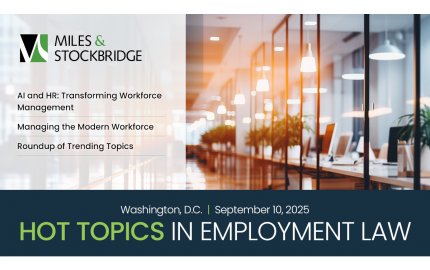
Business executives, human resources professionals and in-house counsel attended last week’s D.C. Hot Topics in Employment Law Seminar, presented by Miles & Stockbridge’s Labor, Employment, Benefits & Immigration Practice Group. The event was an encore and updated presentation of the practice group’s Hot Topics in Employment Law Seminar held annually in February in Baltimore.
Topics included the use of AI in workplace and performance management; myriad employment issues raised on a day-to-day basis with human resources professionals, including disability and religious accommodations and
The Court of Appeals for the Federal Circuit has resolved once and for all the question of who can file a bid protest before the Court of Federal Claims (COFC).
In Percipient.ai, Inc. v. United States, its Aug. 28 precedential decision, the court – sitting en banc – held that only actual or prospective offerors qualify as “interested parties” under the Tucker Act.
As we previously discussed, a panel of the Federal Circuit ruled in June 2024 that Percipient.ai Inc. had standing to
We previously discussed how the work of the Trump administration’s Department of Government Efficiency (DOGE) is making the decision to protest more critical than ever for offerors, particularly as the end of fiscal year rush to award contracts begins to play out. For awardees, the decision to intervene is just as critically important.
Every contract won is becoming more valuable in relation to what, for many contractors impacted by the DOGE effect, is a waning universe of contracting opportunities. By intervening,
By now, anyone who has had their finger on the pulse of government contracting is keenly aware of the impact the Trump administration’s Department of Government Efficiency (DOGE) has had on acquisitions. As of this writing, DOGE claims the amount of dollars saved because of the 13,000-plus contracts terminated to be greater than $58 billion. And while that figure has been debated and, even if accurate, would represent only a small fraction of the hundreds of billions of dollars the
Freddie Mac published a Guide Bulletin on Aug. 26 that imposes new requirements on mortgages originated on or after Oct. 1, 2025. These requirements should be familiar to those who also originate Fannie Mae loans. Freddie Mac now requires that Optigo Lenders deliver the following items in the full delivery package:
For acquisitions loans:Copies of any property-seller-side settlement statements
For all loans:Copies of all documents that evidence the chain of title for the 36-month period preceding the mortgage origination;
A copy of the
The U.S. Supreme Court agreed last week to permit the National Institutes of Health (NIH) to terminate hundreds of grants related to diversity, equity and inclusion (DEI) initiatives worth approximately $800 million. The order was issued in response to the government’s emergency request to stay a lower court injunction barring the termination of the grants. The Supreme Court held that suits challenging these terminations must be brought before the Court of Federal Claims (CFC) and that, conversely, the federal district
This is part of a series discussing state-level bid protests in the DMV. Click here to read about the process in D.C. and click here to read about the process in Virginia.
Protest procedures in Maryland are less centralized than D.C. but more centralized than Virginia.
Generally Relevant Law
The majority of relevant authorities in Maryland are found in Division II of the State Finance and Procurement Article in the Maryland Code (SF&P) and Title 21 of the Maryland Code of Regulations (COMAR).
Authority to
U.S. Attorney General Pam Bondi recently issued new guidance aimed at clarifying the current administration’s stance on the permissibility of diversity, equity and inclusion policies and procedures under federal anti-discrimination laws such as Title VII of the Civil Rights Act of 1964 and Title IX of the Education Amendments Act of 1972 – particularly among entities that receive federal funding, such as schools, universities, state and local governments, health care providers, nonprofits and other private employers.
In its guidance, the Department
On Aug. 6, Colorado became the second state to enact the Uniform Antitrust Premerger Notification Act (APNA), following Washington earlier this year. Under the APNA, a person making a Hart-Scott-Rodino (HSR) filing on or after the effective date of the act must provide a copy of its federal submission to that state’s attorney general if the notified transaction has a sufficient nexus to the state.
Here are some key of the highlights of Colorado’s version of the APNA.
Who Must File
An HSR-reporting
The Centers for Medicare and Medicaid Services (CMS) published its proposed 2026 Medicare Physician Fee Schedule on July 14. The agency’s announcement emphasized “significantly cutting spending waste, enhancing quality measures, and improving chronic disease management for people with Medicare.” While the fee schedule is still under review, and CMS is soliciting suggestions and public comment, health care providers should familiarize themselves with what CMS has proposed.
Here are some key highlights.
Enhancing Payment & Quality Measures: Revised Physician Payment Rates & Telehealth
This is part of a series discussing state-level bid protests in the DMV. Click here to read about the process in D.C. and click here to read about the process in Maryland.
In the Commonwealth of Virginia, decentralization is the rule. Virginia state law generally vests procurement authority in the individual agency or locality, where a protest can move very quickly from submission to the awarding procurement authority onto appeal at the circuit court. With these principles in mind, here is a
On July 8, 2025, President Trump issued an order to unwind the acquisition of Jupiter Systems, Inc., a U.S. company, by Hong Kong-based Suirui International Co., Ltd., a subsidiary of China’s Suirui Group (collectively Suirui), five years after the transaction closed. According to the Treasury Department’s July 11 statement, the Committee on Foreign Investment in the United States (CFIUS) had “identified a national security risk arising from Suirui’s ownership of Jupiter relating to the potential compromise of Jupiter’s products used
Fannie Mae recently announced updates to its Multifamily Loan Documents with Lender Letter (25-04). Since that time, Fannie Mae released a revised Lender Letter (25-04R) that changed the mandatory date for use of the loan documents from July 28, 2025 to August 4, 2025. The updates may be used immediately and must be used for: (i) all Mortgage Loans (other than forward conversions), with a confirmed Commitment Date on or after August 4, 2025, and (ii) forward conversions occurring on
On April 4, Washington became the first state to enact the Uniform Antitrust Premerger Notification Act (APNA). Under the APNA, a person making a Hart-Scott-Rodino (HSR) filing on or after July 27, 2025 must provide a copy of its federal submission to the Washington attorney general if the notified transaction has a sufficient nexus to the state.
Here are some key takeaways as you plan upcoming transactions.
Who Must File
An HSR-reporting party must contemporaneously furnish a copy of its HSR filing to
The Department of Justice (DOJ) recently issued its annual Health Care Fraud Takedown results, announcing a record-breaking 324 defendants, including 96 doctors and licensed professionals, as well as more than $14.6 billion in intended loss. While the large figures grab attention, an analysis of the DOJ’s statements offers important insight for American health care professionals and companies: Despite various executive orders and policy changes with the new administration, the DOJ and other government agencies continue to focus significant resources on
This is part of a series discussing state-level bid protests in the DMV. Click here to read about the process in Virginia and click here to read about the process in Maryland.
For a contractor who just expended significant time and money to bid on a DMV state-level government contract, only to watch the award go elsewhere, disappointment is understandable. But is this the end? What if the contractor believes that the state agency got it wrong? Can the contractor do anything? If so,
Noncompete provisions for most health care professionals will be banned or restricted in Maryland as of July 1. Last year, the Maryland General Assembly passed House Bill 1388, significantly impacting the enforceability of noncompete provisions for health care professionals. A noncompete provision is a post-employment restrictive covenant that prohibits an employee from obtaining subsequent employment, including self-employment, in the same or similar business or trade as their former employer. Noncompete provisions are often limited in geographic scope and time. Under
Maryland Gov. Wes Moore recently signed the $67 billion state budget for 2026 (HB 352) that will make significant changes to the state’s tax system. Among other changes, the budget bill notably establishes a new tax on IT services; imposes a surtax on capital gains; and increases the sales and use tax rate on cannabis. Here is how these key tax provisions might impact individuals, businesses and consumers.
IT Services Tax
(HB 352, Section 9, amending Md. Code Ann., Tax-Gen. § 11-104)
The bill establishes
The Maryland Attorney General’s Office recently announced a series of fair housing enforcement actions, resulting in several major settlements with housing providers across the state. These actions address issues related to source-of-income discrimination, tenant screening practices and minimum-income requirements for voucher holders.
Relevant Federal and State Law
Unlike federal law, Maryland law includes “source of income” as a protected class for discrimination. Under Maryland’s HOME Act, passed in 2020, landlords cannot discriminate against individuals based on their source of income and
A three-judge panel of the United States Court of International Trade late Wednesday afternoon struck down the reciprocal tariffs imposed last month by the Trump administration. The court, in a per curiam decision, held that the powers delegated to the President under the International Emergency Economic Powers Act of 1977 (IEEPA) do not confer the “unbounded authority” to “impose unlimited tariffs on goods from nearly every country in the world.” V.O.S. Selections, Inc., et al. v. United States, No. 25-00066
Less than two weeks after President Donald Trump announced that his administration would lift U.S. sanctions on Syria, the U.S. Departments of the Treasury and State took significant first steps to provide the anticipated sanctions relief.
On May 23, the Treasury Department’s Office of Foreign Assets Control (OFAC) issued General License 25 (GL 25), authorizing a broad range of transactions that had previously been prohibited under the Syrian Sanctions Regulations. In parallel, the State Department exercised its authority under the Caesar
The Maryland General Assembly’s 2025 legislative session concluded with a few impactful health care bills. The two bills below, signed into law by Gov. Wes Moore on Tuesday, represent significant steps in improving health care accessibility and affordability for Maryland residents.
Lowering Prescription Drug Costs for All Marylanders Now Act
This bill increases the authority of Maryland’s Prescription Drug Affordability Board. Created by the General Assembly in 2019, the board was the nation’s first independent body with authority to review affordability
Washington Gov. Bob Ferguson on May 13 signed the Securing Timely Notification and Benefits for Laid-Off Employees Act into law. Effective July 27, this statute mirrors the federal Worker Adjustment and Retraining Notification (WARN) Act, establishing notice requirements for certain business closures and mass layoffs in Washington.
Here’s what employers need to know.
Who’s Covered?
Employers with 50 or more employees in Washington, excluding part-time workers – but does not extend to state and local governments or political subdivisions.
All Washington employees, including part-time
President Donald Trump announced Tuesday during his trip to the Middle East that his administration would lift U.S. sanctions on Syria.
Since the shock collapse of Bashar al-Assad’s regime in Syria late last year, the United States and broader international community have debated whether sanctions on Syria should be removed. After years of comprehensive restrictions, Syria’s people and economy could benefit dramatically from sanctions relief. If the administration follows through with Trump’s announcement, U.S. and international exporters, financial institutions and other
Continuing a focus on knowing your clients and fraud, Fannie Mae released last week Title and Closing Requirements for Multifamily Mortgage Loans Form 4650, a comprehensive update that will impact how you set up future closings. The requirements detailed in the new Form 4650 apply to all new loans under application on or after May 8, 2025.
What’s New
Approved Title Insurance Underwriter – Fannie Mae will be releasing an Approved Title Insurance Underwriter Schedule naming the Title Insurance Underwriters from which
The Trump administration continues to bring with it changes in both the staff and politically appointed positions within the U.S. Consumer Product Safety Commission (CPSC). On Thursday and Friday, the three Democratic commissioners of the CPSC were fired, effective immediately.
The fired commissioners – Mary Boyle, Richard Trumka Jr. and former CPSC Chair Alex Hoehn-Saric – have already stated their intent to challenge their dismissals in court. Click here to read a statement from former CPSC Chair Alex Hoehn-Saric that summarizes
One now-shuttered digital media startup learned a hard lesson about the importance of complying with the requirements of the federal Worker Adjustment and Retraining Notification Act and its New York state-equivalent.
JAF Communications Inc., operating as The Messenger, agreed to pay $4.5 million to class members for failing to provide advance notice of their mass layoff before the company shut down Jan. 31, 2024. The parties’ joint motion for settlement approval is pending in the U.S. District Court in New York.
The
Some early actions by the Trump administration have led corporate legal departments to question the extent to which they need to invest in ethics and compliance at this time, based on a perceived reduction in enforcement risk:
A presidential action issued in February paused enforcement of the Foreign Corrupt Practices Act, stating “overexpansive and unpredictable FCPA enforcement against American citizens and businesses . . . for routine business practices in other nations . . . wastes limited prosecutorial resources that could
Fannie Mae published its Preferred Equity Guide Update (25-06) and its Preferred Equity Checklist (Form 6441) in mid-April. Although unpublished iterations have been circulating for the past two years, lenders and law firms have interpreted the requirements in varying ways, at times leading to different outcomes for very similar equity structures.
The Krooth & Altman Team at Miles & Stockbridge welcomes this newly published Checklist, as we expect it to bring more clarity and consistency to the treatment of preferred equity structures
Yogi Berra once said, “The future ain’t what it used to be.” Those who have spent a career in federal procurement have seen many cycles of well-intentioned procurement reform instead create a system that is more complex, arcane and inefficient with each iteration.
Any long-serving procurement professional has a bookshelf of Federal Acquisition Regulation (FAR) and Defense Federal Acquisition Regulation Supplement (DFARS) volumes that visibly get thicker with each issue; the current copies are more than twice as thick as the
President Donald Trump issued an executive order (EO) earlier this month announcing sweeping “reciprocal” tariffs on imports from countries across the world. One country missing from the EO’s increased tariffs was Russia, despite its ongoing trade surplus with the United States. In response to the scrutiny this has drawn, the White House offered existing U.S. sanctions on Russia as the basis for its exclusion.
While the EO’s more substantial “reciprocal” tariffs are currently suspended (except for China), these discussions raise the
In a few short weeks, President Donald Trump has issued several executive orders (EOs) that, once implemented, will significantly alter federal procurement. We previously reviewed the EO directing the modernization of defense acquisition processes. Last week, the president issued another EO, “Ensuring Commercial, Cost-Effective Solutions in Federal Contracts,” to fulfill the administration’s goal of eliminating unnecessary and imprudent expenditures of taxpayer dollars by focusing on commercial products and services that provide better, more cost-effective solutions to taxpayers.
This EO directs federal
Executives, general counsel and administrators of hospitals, physician groups, long-term care communities and other health care providers attended last week’s Hot Topics in Health Care Law seminar, presented by the Miles & Stockbridge Health Care Group. The event featured a panel discussion, moderated by Lisa Keenan and Molly Ferraioli, with three industry experts offering their thoughts on the rapidly evolving landscape of health care law:
Cathy Hamel, president of Gilchrist Hospice, the largest provider of serious illness, hospice and palliative care
President Donald Trump signed an executive order April 9, “Modernizing Defense Acquisitions and Spurring Innovation in the Defense Industrial Base,” to reform the United States’ “antiquated defense acquisition processes.” The EO is intended to rectify “years of misplaced priorities and poor management” by improving the speed, flexibility and execution of defense acquisitions and eliminate perceived waste and inefficiency.
The plan also would modernize the duties of the defense acquisition workforce and incentivize and reward personnel for risk-taking and innovation. Given the
Three years after Maryland’s Paid Family and Medical Leave Insurance Program (FAMLI) was established by the Time to Care Act of 2022 (TCA), the General Assembly on Monday passed House Bill 102, which delays certain dates related to annual reporting and the implementation of the program. Gov. Wes Moore is expected to sign the bill into law in the coming weeks.
The bill would delay when employers and employees must begin submitting contributions for the funding of the program and when
The short-term spending bill President Donald Trump signed into law last month included the extension of several telehealth waivers by entering a new termination date of Sept. 30 into the existing law. These waivers, called “flexibilities” by Congress, were first created in response to the COVID-19 public health emergency to allow Medicare beneficiaries to receive care by telehealth, mitigating the risk of the virus spreading. These flexibilities have been temporarily extended since the end of the federal emergency in 2023.
“Build-to-rent” means what it sounds like: A builder constructs single-family homes specifically designed for renters. Also known as “build-for-rent,” these communities began in Phoenix during the Great Recession and have since spread across the Sunbelt. There were 83,000 build-to-rent construction starts last year, accounting for more than 8% of all single-family construction starts. Analysts believe demand will remain strong because the supply of for-sale homes remains tight due to high home prices and mortgage rates.
Developers, investors, lenders and borrowers in
While there have been previous efforts to reduce the federal government’s real estate footprint, the scope and speed with which the Trump administration proposes to reduce that footprint is unprecedented.
Acting through the U.S. General Services Administration (GSA), the administration is targeting a 50% reduction of leased office space. It has instructed the GSA to terminate GSA leases, which has been a source of confusion for landlords with tenants under GSA leases. Although government contracts generally permit federal agencies to terminate
Companies have always faced the potential for a visit from an agent from U.S. Immigration and Customs Enforcement (ICE) but President Donald Trump’s heightened focus on immigration increases the likelihood of that reality. Over the past month, the Trump administration has issued new policies that alter previous guidelines for how ICE agents may act in the line of duty.
Of course, a visit from an ICE agent, like contact with any law enforcement officer, may prompt nervous or inappropriate reactions that
Freddie Mac published Thursday an update to the Freddie Mac Guide, which included a discussion of various underwriting, fraud detection and loan document changes. Here's what you need to know.
Loan Documents/Legal Matters
Most of the changes to the loan documents, including Loan Agreement and Guaranty, are minor and ministerial in nature but widespread.
The biggest change is to incorporate the provisions of splitting the note riders to the Loan Agreement and Guaranty directly into the bodies of the documents. This allows Freddie
The Mortgage Bankers Association hosted its annual Commercial Multifamily Finance Convention and Expo (CREF) in San Diego last week, bringing together industry leaders, experts and professionals. Members of the Krooth & Altman GSE and HUD Team at Miles & Stockbridge headed west to network, exchange insights and engage in dynamic sessions that tackled the fast-changing economic, regulatory and political landscape. Below are some of the key takeaways from the event that are important to know.
Updated Guidance Coming from Fannie Mae, Freddie Mac
Fannie
The acting general counsel for the National Labor Relations Board on Friday rescinded numerous general counsel memoranda on key Biden-era policies and priorities issued by his predecessor. William Cowan’s memorandum indicates the first significant shift in labor policy priorities under the Trump Administration, previewing fewer restrictions on employers in the next four years.
Although GC memos are non-binding, they provide enforcement guidance for NLRB Regional Offices and inform unions and employers of recent developments in board law and policy.
New Priorities Impact
On Feb. 5, National Girls & Women in Sports Day, President Donald Trump signed an executive order titled “Keeping Men Out of Women’s Sports” declaring “it is the policy of the United States to oppose male competitive participation in women’s sports more broadly, as a matter of safety, fairness, dignity, and truth.” The directive is aimed at prohibiting transgender women and girls from competing in women’s sports.
The order directs the Education Department to carry out the policy by changing its
President Donald Trump last week removed National Labor Relations Board member Gwynne A. Wilcox and terminated the board’s general counsel, Jennifer Abruzzo. The president then fired acting General Counsel Jessica Rutter on Feb. 1, replacing her with William Cowan. Although the termination of the general counsel was expected and consistent with actions taken by prior presidents, Wilcox’s removal was the first time a president has removed a sitting board member and potentially sets up a legal battle over the president’s
President Donald Trump signed a number of executive orders in his first week in office with broad implications for federal agencies, contractors and, potentially, private employers. Executive orders only apply to federal agencies and their employees and do not impose requirements on private employers. But private employers should be aware of these issues and prepare for potential impacts on their organizations.
Order on Gender Identity and Expression
Trump signed an executive order Jan. 20, titled “Defending Women From Gender Ideology Extremism and
The Equal Employment Opportunity Commission (EEOC) recently issued guidance to assist health care providers in addressing their patients’ needs for accommodation under the Pregnant Workers Fairness Act (PWFA). The PWFA requires employers with 15 or more employees to provide reasonable accommodations for employees with known limitations related to or arising out of pregnancy, childbirth and related medical conditions, unless the accommodation will cause the employer an undue hardship. The EEOC’s guidance is intended to aid health care providers in understanding
Employers are breathing a sigh of relief after the U.S. Supreme Court last week unanimously confirmed the application of a “preponderance of the evidence” standard to an employer’s burden of proof when it seeks to establish that an employee is exempt from the minimum wage and overtime pay provisions of the Fair Labor Standards Act (FLSA).
How Did We Get Here?
The Supreme Court sought to resolve a split among federal circuit courts to determine whether employers need only demonstrate by
Government agencies may be eager to exercise their enhanced authority to investigate and pursue contractors under provisions in the newly enacted Administrative False Claims Act (AFCA). The two key changes discussed below could increase the number of claims that agencies may find appealing to investigate.
Although these changes affect contractors of any size, small business contractors are likely to find investigations more disruptive if they lack a robust compliance program. But there are ways they can protect themselves by preparing for
The 2nd U.S. Circuit Court of Appeals earlier this month vacated a lower court’s permanent injunction that had prevented the employer notice requirement in New York’s reproductive health bias law from taking effect. The appellate court’s decision in Compass Care v. Hochul means New York employers that have employee handbooks must now include notice of employee’s rights and remedies under the reproductive health bias law in those handbooks.
The reproductive health bias law, which took effect in 2020, prohibits employers from
The Federal Trade Commission (FTC) announced Jan. 10 annual revisions to the applicable thresholds under the Hart-Scott-Rodino Antitrust Improvements Act of 1976, as amended (the HSR Act). These revisions will apply to all transactions closing on or after the effective date of the notice, which will be 30 days after its publication in the Federal Register. The new minimum size of transaction threshold has been adjusted upward from $119.5 million to $126.4 million.
Under the HSR Act, the parties to any
This website does not track your personal or demographic information, only anonymous usage statistics. To ensure that you are not tracked, we have blocked all embedded content from third party sources like YouTube and SlideShare. Click "Accept Cookies" to enable third-party content. To learn more about our cookie policy, click here.