Effective immediately, U.S. Customs and Border Protection (CBP) is amending the CBP regulations to permit importers to temporarily postpone the deposit of certain estimated duties, taxes and fees. Ordinarily, those estimated duties, taxes and fees must be paid by importers for their merchandise as of the date of its entry, or its withdrawal from warehouse, for consumption. However, for certain merchandise entered in March or April 2020, qualified importers may postpone payment for a period of 90 days from the
Employees concerned about the coronavirus and its impact on their health and that of their family members have been speaking out in the workplace, on social media and in the press. Employees have been raising issues such as social distancing in the workplace, available safety equipment and disinfecting their workspaces. There have been a number of recent articles concerning discipline issued to employees for raising those concerns. Employees’ concerns and discussions about those concerns are likely to increase as businesses
As businesses continue to wait for curves to begin to flatten, there is little doubt that there will be increased pressure to resume operations as quickly as possible. Businesses should begin to consider now how they will comply with best practices to safeguard employees and avoid situations that put their employees at risk.
Jeff Johnson’s March 26 blog post touched on OSHA’s emphasis to that date and is a good starting place for professional managers trying to anticipate problems that good
On March 5, 2020, Maryland Governor Larry Hogan proclaimed a state of emergency related to COVID-19. Pursuant to that proclamation, Governor Hogan and the Office of the Comptroller of Maryland (the “Comptroller”) have taken various actions to provide Maryland citizens with tax and reporting relief. Additionally, on March 23, 2020, Governor Hogan authorized $130 million in funding for the Maryland COVID-19 Emergency Relief Fund Programs for Small Businesses (the “Relief Fund”) and $7 million in funding for the COVID-19 Layoff
One of the few good things about a pandemic is that it can trigger the human instinct to share. If you are thinking about adopting or expanding a leave-sharing or PTO donation program, remember to consider the tax consequences to employees.
The simplest form of a leave-sharing program is where one employee donates PTO to another employee or an employer-managed PTO bank. The donated PTO can be used by another employee for any reason or for certain reasons specified by the
On April 14, 2020, Maryland Governor Larry Hogan issued Executive Order 20-04-14-02 intended to provide publicly traded Maryland corporations and real estate investment trusts with greater flexibility in holding stockholder meetings by remote communication. Applicable to Maryland corporations and REITs that are subject to the reporting requirements of the ’34 Act, the Executive Order will remain in effect until Maryland’s state of emergency has been terminated and the proclamation of the catastrophic health emergency has been rescinded.
The Executive Order will
Last month, the U.S. District Court for the District of Montana granted summary judgment to an environmental group, ruling that the U.S. Army Corps of Engineers violated Section 7(a)(2) of the Endangered Species Act (“ESA”) by failing to formally consult with the U.S. Fish and Wildlife Service or the National Marine Fisheries. The Court held that the Corps’ re-issuing its Nationwide Permit 12 (“NWP 12”) without complying with the ESA “may affect” protected species or critical habitat.
Nationwide permits are available
On April 9, 2020, the IRS issued Notice 2020-23 (the “Notice”), which extends additional tax deadlines to cover individuals, estates, corporations and others. The Notice also provides relief with respect to certain “Specified Time-Sensitive Actions” that are due to be performed on or after April 1, 2020, and before July 15, 2020. For purposes of the Notice, the term “Specified Time-Sensitive Action” includes certain deadlines for taxpayers to identify property and complete a 1031 exchange. It also includes the prescribed
Section 3610 of the Coronavirus Aid, Relief, and Economic Security (CARES) Act, enacted on March 27, 2020, provides the possibility of welcome financial relief for many federal contractors struggling to stay afloat during the COVID-19 pandemic. Subject to certain prerequisites and constraints, Section 3610 permits agencies to reimburse, at “the minimum applicable billing rate not to exceed an average of 40 hours per week any paid leave, including sick leave, a contractor provides to keep its employees in a ready
In my last post, “Real Estate Alphabet Soup: L Is for Lease” I continued my primer on the “alphabet soup” of real estate. This post continues to stir the “alphabet soup” with the letter “M.”
As I write this blog, we are in the midst of the COVID-19 coronavirus pandemic. So I’m working remotely from home and “social distancing” to do my part and civic duty in helping to “flatten the curve” and slow the spread of the virus.
When I first
On April 9, 2020, the IRS issued Notice 2020-23 (the “Notice”), which extends more tax deadlines to cover individuals, estates, corporations and others. The notice expands upon tax relief granted in prior IRS notices that postponed certain tax filing and payment deadlines until July 15, 2020. The Notice provides extensions for a variety of tax form filings and payment obligations that are due between April 1, 2020, and July 15, 2020, including estimated tax payments due June 15 and the
Is COVID-19 a disability under the ADA?
To qualify as disabled under the Americans with Disabilities act, an individual must be:
A person who has a physical or mental impairment that substantially limits one or more major life activities;
A person who has a record of such an impairment; or
A person who is regarded as having such an impairment.1
According to recent guidance released by the EEOC in a March 27 webinar, it is unknown whether COVID-19 would itself qualify as a disability under
The COVID-19 pandemic is creating havoc on all business sectors, including the commercial real estate industry. Among many challenges are determining safe and secure mechanisms for documenting business transactions and coordination and transmittal of the information needed to consummate them. This is an appropriate time to revisit the benefits of blockchain, a transparent and secure method of document and information delivery, which has the added benefit of reducing personal interaction between the participants to the transaction.
Blockchain, once known primarily as
The Coronavirus Aid, Relief, and Economic Security (CARES) Act and the Family First Coronavirus Response Act (FFCRA) contain provisions to help employers maintain their workforces. Notably, the relief available to employers under both Acts focuses on payroll and extends to certain nonprofit organizations. Below is a description of the relief available to nonprofit organizations under the CARES Act and FFCRA.
Paycheck Protection Program
Under the CARES Act, the federal government created the Paycheck Protection Program (PPP) to assist small businesses, including nonprofits,
On April 3, 2020, in response to the ongoing COVID-19 pandemic, Chief Judge Mary Ellen Barbera of the Maryland Court of Appeals issued a trio of administrative orders. One of the orders—“Administrative Order on Tolling or Suspension of Statutes of Limitations and Statutory and Rules Deadlines Related to the Initiation of Matters and Certain Statutory and Rules Deadlines in Pending Matters”—is sure to catch the attention, and raise questions, for litigators across the state.
What Does the Order Say?
Under sections (a)
On March 27, 2020, President Trump signed into law the Coronavirus Aid, Relief, and Economic Security (or “CARES”) Act, the largest stimulus in American history (the “Act”). The Act expands eligibility and loosens restraints on the Section 7(a) Loan Program of the U.S. Small Business Administration (“SBA”), authorizes up to $349 billion in new Paycheck Protection Program Loans (“PPP Loans”), makes them 100% (rather than 75%) guaranteed and provides for PPP Loan forgiveness in certain circumstances.
On April 2, 2020, the
The Coronavirus Aid, Relief, and Economic Security Act (“Act”) contains several business relief provisions, including an employer payroll tax deferral (“Deferral”) and a companion provision allowing an employee retention credit (“Credit”).
1. Deferral
The Act allows for deferral of the employer portion of Social Security tax imposed by I.R.C. Section 3111(a). Deferral does not apply to employee income tax withholding, the employee or employer portion of the Medicare tax, or the employee portion of the Social Security tax.
There are no employer eligibility requirements
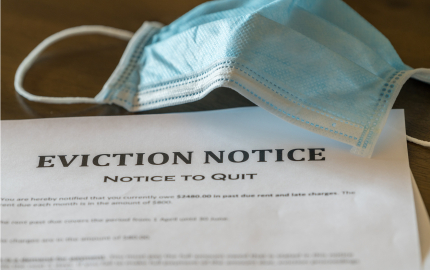
On Friday, April 3, 2020, Maryland Governor Larry Hogan issued Executive Order 20-04-03-01, which amended and restated his March 16, 2020, Executive Order in its entirety. In the March 16 Executive Order, Governor Hogan placed temporary prohibitions on evictions for residential real property. The April 3 Executive Order extended that temporary prohibition to commercial and industrial real property.
Therefore, until the current state of emergency is terminated and the catastrophic health emergency is rescinded, no Maryland court may grant judgment for
On April 1, 2020, the IRS finalized Form 7200 – Advance Payment of Employer Credits Due to COVID-19 and the accompanying instructions. The Form provides additional guidance for eligible employers to take advantage of refundable tax credits under the Families First Coronavirus Response Act (FFCRA) and the Coronavirus Aid, Relief and Economic Security Act (CARES) Act.
Background
Employer Relief under the FFCRA. Under the FFCRA, an eligible employer’s costs associated with required paid family and sick leave are offset dollar-for-dollar (up to
On March 30, 2020, the Secretary of the Department of Health and Human Services (HHS) acted pursuant to the declared COVID-19 public health emergency and granted blanket waivers—effective March 1, 2020—of certain provisions of Section 1877(g) of the Social Security Act, otherwise known as the Physician Self-Referral (or “Stark”) Law.
The Stark Law prohibits a physician from making referrals for certain designated health services payable by Medicare to an entity with which he or she (or an immediate family member) has
Governor Hogan, in conjunction with the Maryland State Department of Education (MSDE), has taken action to ensure that child care is available and free for essential personnel during the pandemic. Initially, Governor Hogan permitted MSDE to waive certain regulations so that child care centers would have capacity to accommodate children of emergency workers. However, last week, Governor Hogan and MSDE went further and ordered all child care centers to close unless the centers provide services to “essential persons.” The Executive
On March 27, 2020, President Trump signed into law the Coronavirus Aid, Relief, and Economic Security (CARES) Act, H.R. 748 (the “Act”), which contains a host of tax measures as part of a $2 trillion aid package to provide economic stimulus in the wake of the COVID-19 pandemic. While the focus of the legislation is not tax, a large number of tax provisions are included in the Act, which affect both individuals and businesses.
Important Note: The following is a general summary of
The spread of COVID-19 is taking the world by storm with unprecedented and far-ranging consequences. During this extraordinary time, many employers are dealing with difficult issues regarding their workforces amidst office closures, shelter-in-place orders and other disruptions. Below we provide general guidance to common questions and scenarios with respect to workers in H-1B status during this challenging time, although particular cases will require an individualized assessment.
1. Can an H-1B worker be furloughed or placed in other unpaid leave status?
No, an
In response to the significant challenges related to the COVID-19 pandemic, the U.S. Department of Homeland Security (DHS) and the Department of State (DOS) have recently implemented temporary operational changes and immigration-related measures. Below are some of the important updates impacting U.S. employers and their foreign national workers.
Suspension of Routine Visa Services by the DOS
The DOS is temporarily suspending routine, non-emergency visa services at all U.S. embassies and consulates. Embassies and consulates will cancel all routine immigrant and nonimmigrant visa
The United States Environmental Protection Agency (EPA) has staked out its position on environmental compliance during the COVID-19 pandemic with the issuance of a temporary policy on how it will apply enforcement discretion to violations resulting from the pandemic. While the policy was just issued on March 26, 2020, it will apply retroactively beginning March 13, 2020, and does not yet have an end date. EPA will be assessing the need for the policy on a regular basis and has
In light of the COVID-19 pandemic, Maryland corporations and their boards of directors are reassessing previously authorized and declared distributions (aka dividends) to stockholders. Here’s what you need to know:
If the board of directors has “authorized” the distribution, but not made any public announcement or “declared” the distribution, the distribution may be freely rescinded by board action.
If shares of stock receiving the distribution are traded on an exchange and the ex-dividend date has passed, in addition to the state law
Many jurisdictions, including Maryland, the District of Columbia and Virginia, have faced court closures and other logistical issues surrounding the current COVID-19 emergency. This is in addition to proclamations and orders issued by the Department of Housing and Urban Development that have placed a moratorium on foreclosures and evictions for millions of Americans with FHA-insured mortgages for a period of 60 days. This article highlights the temporary changes to the foreclosure and eviction process in Maryland, D.C. and Virginia.
Maryland
In Maryland,
Unfortunately, many of the regulations governing employers’ obligations to their employees provide little guidance on how to navigate a global health pandemic like coronavirus. This is particularly true for regulations issued by the Occupational Safety and Health Administration (OSHA), which are the primary source of an employer’s obligations to provide a safe working environment, but are ill-suited to address the current health crisis. To provide clarity on the obligations of employers relating to Coronavirus, OSHA recently created a COVID-19 Resource
The U.S. Department of Labor (DOL) yesterday issued its Families First Coronavirus Response Act (FFCRA) “Employee Rights Paid Sick Leave and Expanded Family and Medical Leave under The Families First Coronavirus Response Act” poster for most public employers and private employers with fewer than 500 employees to post in the workplace. The poster informs employees of their rights under the FFCRA. The DOL also posted helpful frequently asked questions concerning the poster.
The frequently asked questions clarify that the posting requirement
Effective as of 10 p.m. on March 25, 2020, Mayor Muriel Bowser ordered cessation of all onsite operations of non-essential businesses that cannot be performed at home except for “Minimum Basic Operations.” The Order is effective through April 24, 2020, and prohibits gatherings of more than 10 people in an attempt to prevent the further spread of the coronavirus.
Non-Essential Businesses.
The order requires the cessation of all non-essential businesses in the District of Columbia other than those that can be conducted
Annual Shareholder Meetings
As Virginia corporations navigate this year’s annual shareholder meeting season, many have come face-to-face with the COVID-19 pandemic. The social distancing requirements related to the pandemic will often deter—or prevent—in-person shareholder meetings. At the same time, there is disinformation circulating regarding the availability of virtual shareholder meetings under Virginia law. Here are the key points:
Governor Northam’s Executive Order #53 of March 23, 2020, expressly bans all public and private in-person gatherings of 10 or more individuals. This applies
On March 22, 2020, the Centers for Medicare & Medicaid Services (CMS) implemented substantial administrative relief for clinicians, providers and facilities participating in Medicare quality reporting programs, including widely implemented programs like Medicare Shared Savings Program Accountable Care Organizations (ACOs) and the Merit-based Incentive Payment System (MIPS). These measures include extensions of deadlines and delays in reporting requirements for certain quality programs in order to alleviate the administrative burden on health care providers during the COVID-19 crisis. For example, CMS
On March 24, 2020, the Department of Labor issued its first published guidance relating to the Emergency Paid Sick Leave (EPSL) and Emergency FMLA (EFMLA) established under the Families First Coronavirus Response Act (FFCRA). For a full explanation of the FFCRA, please see our prior blog. The three guidance documents from the DOL are available here, here and here.
The most notable piece of information is that the law is going into effect a day earlier than anticipated—on April 1, 2020.
Employers with a unionized workforce are familiar with the general prohibition under the National Labor Relations Act (NLRA) against unilaterally changing terms and conditions of employment that are specifically covered by an existing collective bargaining agreement (CBA). For terms and conditions not specifically covered by an existing CBA, employers also know that they may not make changes without bargaining to an agreement or reaching an impasse over those issues. However, what may an employer do when faced with an unforeseen
On Monday, March 23, 2020, Governor Northam issued Executive Order 53 (“EO53”) ordering the statewide closure of recreational and educational businesses to the public, non-essential retail businesses, all K-12 schools for the remainder of the academic year, banning all gatherings of more than 10 people, and restricting Essential Retail Businesses and Professional Service Businesses to complying with the CDC guidelines. This order went into effect yesterday (Tuesday March 24, 2020, at 11:59 p.m. and will remain in place until 11:59 p.m.
As the Coronavirus (COVID-19) spreads, a growing number of employers are considering terminating or furloughing employees. This has raised a number of Maryland unemployment compensation questions that, although not specifically related to the COVID-19 pandemic, result from its effects on employees and employers alike. This article provides guidance on the most common COVID-19 related unemployment issues.
Determining a claimant’s weekly benefit amount (WBA) in Maryland.
A claimant’s WBA is approximately 54% of gross weekly wages up to a maximum of $430 per
On March 20, 2020, the United States Trade Representative (USTR) announced that it was accepting public comments on possible modifications to the tariffs imposed on Chinese products as a part of the Section 301 action to address “China’s acts, policies and practices related to technology transfer, intellectual property and innovation.” See. Although many medical/health-related products were excluded from these tariffs, the USTR is seeking identification of additional products currently subject to the tariffs that may be beneficial to combatting the
On March 23, 2020, the Maryland Secretary of Health issued an Order and Directive (the “Directive”) that addresses a number of different health care issues for the prevention and control of COVID-19. One area addressed is the postponement of elective surgery. The Directive orders all Maryland licensed hospitals, ambulatory surgery centers and other licensed health care facilities to cease all elective and non-urgent medical procedures effective as of 5 p.m. on Tuesday, March 24, 2020, and to not permit any
A key tool in mitigating the risks due to unforeseen events is the force majeure clause contained in many commercial and other types of contracts. In various states, including Maryland, residential and commercial construction companies have been deemed “essential” and may remain open even when a shelter-in-place order has been executed by a state’s Governor. So how will COVID-19 affect construction contracts and, in particular, will a force majeure clause contained in a construction clause provide any relief should delays
As Maryland corporations navigate this year’s proxy season, many have come face-to-face with the COVID-19 pandemic. The social distancing requirements related to the pandemic will often deter—or prevent—in-person stockholder meetings. At the same time, there is disinformation circulating regarding the availability of virtual stockholder meetings under Maryland law. Here are the key points:
If the bylaws authorize the board of directors to determine the place of a stockholder meeting, Maryland corporations may cause a stockholder meeting to be held as a
To assist our clients with properties in Montgomery and Frederick Counties, and the Cities of Gaithersburg, Rockville and Frederick, with understanding how the Covid-19 related closures may affect their pending and anticipated land use and regulatory entitlement reviews, we offer below a summary of how the various jurisdictions are approaching the situation. This information is current as of March 22, and is subject to change at any point. For further information, or to better understand how these closures may impact
Earlier today, Governor Hogan enacted Amended and Restated Executive Order (20-03-23-01) closing all non-essential businesses in the State of Maryland by 5 p.m. today. Here’s what you need to know:
Non-Essential Businesses include all businesses, organizations, establishments and facilities that are not part of the critical infrastructure sectors identified by the U.S. Department of Home Security’s Cybersecurity and Infrastructure Security Agency. If your business is included in a designated critical infrastructure sector, and therefore an Essential Business, it is not impacted
With the novel coronavirus (COVID-19) causing Employers to switch to teleworking or temporarily shuttering their operations, government contractors have special challenges. Some employees of government contractors may not be able to work remotely under the terms of the government contract and others who perform classified work or need access to government networks may not be able to telework. Therefore, due to COVID-19, temporary furloughs of employees working for government contractors are likely. Government contractors should plan now for possible furloughs
On Monday, March 16, 2020, Governor Hogan, in an effort to slow the spread of the coronavirus, by executive order, ordered the closure of all Maryland bars, restaurants, movie theaters, and gyms until such time as the state of emergency, declared by Governor Hogan on March 5, 2020, is terminated and the proclamation of the catastrophic health emergency has been rescinded or until the executive order is otherwise rescinded, superseded, amended or revised by additional orders. During that time, however,
On March 18, 2020, the United States Senate passed the revised “Families First Coronavirus Response Act,” (“FFCRA”) that had been passed by the United States House earlier this week, which President Trump has now signed. The FFCRA becomes effective within 15 days (April 2, 2020), so employers should immediately begin preparations to ensure compliance with the law.
Importantly, the new law does not require that employers provide paid leave for employees who are off work just because of an office closure.
As of March 18, 2020, Maryland regulators have temporarily suspended certain child care licensure requirements in order to expand access to child care for school-age children of “emergency personnel.” The state has identified “emergency personnel” as employees who work in hospitals and first responders such as fire, police, doctors and nurses. The State Superintendent of Schools for the Department of Education (the state agency responsible for licensing child care centers) took this action in response to the Executive Order issued
With the numerous changes to working procedures as a result of COVID-19, the impact on the Maryland State Department of Assessments and Taxation (SDAT) is no different. For filings that are unable to be completed online, SDAT is currently working on a plan for arranging appointments and/or scheduling times for the drop-off of documents and filings. SDAT continues to assess its resources and capabilities.
Currently, SDAT is closed to the public and that is unlikely to change soon. If SDAT is
Senate Bill 1080 which was cross-filed with House Bill 1663, were recently passed by both the House (March 17, 2020) and the Senate (March 18, 2020). The Bill is on its way to Governor Hogan, who is expected to sign it into law.
Among other issues, the Bill expands employees’ eligibility for unemployment compensation due to the impact of the current COVID-19 health emergency. Specifically, the Bill provides that an employee need not separate from employment to be eligible for unemployment
As the marketplace slows in response to the worldwide spread of COVID-19, companies are (or should be) breaking out their contracts and subcontracts to see what they say to protect themselves from current and future problems. Here are the critical provisions.
All Contractors and Subcontractors
All companies should review their contracts and subcontracts for force majeure clauses. The critical issues related to these clauses are outlined in two articles posted to our Coronavirus Task Force website. The articles can be found here
On March 16, 2020, the United States House of Representatives passed a “corrected” version of the Families First Coronavirus Response Act (FFCRA), which made some notable changes to the provisions impacting employers.
The FFCRA’s major requirements for employers relate to paid leave, as follows:
Emergency Paid Sick Leave (EPSL). Private employers with fewer than 500 employees and all public employers must provide 80 hours of paid leave to all full-time employees who need to miss work because of illness or quarantine, or
This website does not track your personal or demographic information, only anonymous usage statistics. To ensure that you are not tracked, we have blocked all embedded content from third party sources like YouTube and SlideShare. Click "Accept Cookies" to enable third-party content. To learn more about our cookie policy, click here.